

On The Third Temple (Part II)
And still it lies desolate…

“Has your Majesty never heard that when Julian commanded the temple at Jerusalem to be restored, they who cleared away the rubbish were destroyed by fire from heaven?
Are you not afraid lest this should now happen?”
— Ambrose of Milan, Letter to Emperor Thedosius (Letter XL, §12)
Get Scipio’s latest book, The Empire of Lies: the American Empire unmasked.
Hit the Tip Jar and help spread the message!
This post contains affiliate links, which means I may receive a commission or affiliate fee for purchases made through these links.
Unlock the mysteries of Biblical cosmology and enrich your faith with some of the top rated Christian reads at BooksOnline.club.
Click the image below and be sure to use promo code SCIPIO for 10% off your order at HeavensHarvest.com: your one stop shop for emergency food, heirloom seeds and survival supplies.

Related Entries


The tale of the Emperor Julian and his doomed attempt to revive the Temple is an enduring warning to those who wish to renew such endeavors in our time.
Julian, dubbed the Apostate, the last of the pagan emperors of Rome, ascended to the purple in 361 A.D. His uncle Constantine the Great had, decades prior, set the imperial seal upon the Church, and his successors, for all their political failings, did not reverse that course. Raised as a nominal Christian but steeped in Hellenic philosophy, Julian was a shameless self promoter, styling himself as the restorer of the old gods. Though his reign would be short lived, his revolt against the Church, like all revolutions, required a symbolic target.
Enter Jerusalem. The city still bore the scars of Titus’ fury, and the Temple remained a ruin — just as Christ had said it would: “Not one stone shall be left upon another.” What better rebuke to the Christians than to raise up again that which their Messiah had declared desolate?
Julian’s letter to the Jews of Rome is cloying in its flattery (emphasis mine):
…those who are in all respects free from care should rejoice with their whole hearts and offer their suppliant prayers on behalf of my imperial office to Mighty God, even to him who is able to direct my reign to the noblest ends, according to my purpose. This you ought to do, in order that, when I have successfully concluded the war with Persia, I may rebuild by my own efforts the sacred city of Jerusalem, which for so many years you have longed to see inhabited, and may bring settlers there, and, together with you, may glorify the Most High God therein.
— Emperor Julian the Apostate, To the community of the Jews (The Works of Emperor Julian, Vol. III, Letter 51)
The Apostate’s efforts in Jerusalem were the culmination of his agenda against the Church. Imperial resources were devoted to the project, and no expense was spared: Julian appointed Alypius of Antioch, a seasoned administrator, to oversee the effort. That he chose the Temple, and the Jews, to stage this humiliation, reveals both his cunning and his contempt.
Yet, as we shall see, Heaven is not mocked so easily.
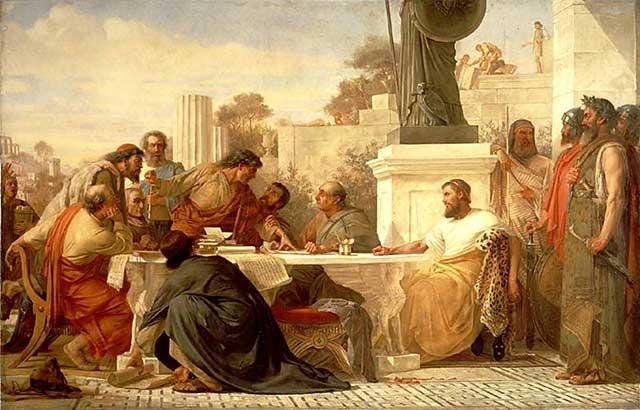
— Julian the Apostate presiding at a conference of sectarians (1875) , ill. by Edward Armitage.
“[Emperor] Julian rose up as one who pretended love for the Jews, promising that he would even offer sacrifice in their temple. They were to enjoy a little help from him, and a great number of the Gentiles … were to join themselves to their party, although falsely and insincerely. For it would only be for the sake of their own idolatrous religion that they would pretend friendship to the Jews.”
— Jerome of Stridon, Commentary on Daniel (Ch. 11)
The lines were drawn: on one side stood the emperor, armed with the imperial coffers and a dream of reversing the Christian age; on the other, stood the Word of Christ. What unfolded is recorded by both secular and Christian observers alike: the attempt was stymied through what can only be described as an act of God.
To begin we must familiarize ourselves with the ancient sources. Our first witness is Gregory of Nazianzus, the fourth-century Archbishop of Constantinople, and one of the Cappadocian Fathers. His Second Invective Against Julian the Emperor is the fiery record of a man who had seen Julian’s apostasy up close. The emperor, having failed to uproot the Church by political edict, attempted to falsify prophecy instead. Gregory identifies the revivification of the Temple as the final weapon in Julian’s arsenal against the Church. He writes (emphasis mine):
He [Julian] was daily growing more infuriated against us [Christians], as though raising up waves by other waves, he that went mad first against himself, that trampled upon things holy… For when he had exhausted every other resource, and despised every other form of tyranny in our regard as trifling and unworthy of him (since there never was a character so fertile in finding out and contriving mischief), at last he stirred up against us the nation of the Jews, making his accomplice in his machinations their well-known credulity, as well as that hatred for us which has smouldered in them from the very beginning; prophesying to them out of their own books and mysteries that now was the appointed time come for them to return into their own land, and to rebuild the Temple, and restore the reign of their hereditary institutions — thus hiding his true purpose under the mark of benevolence.
And when he had formed this plan, and made them believe it (for whatever suits one’s wishes is a ready engine for deceiving people), they began to debate about rebuilding the Temple, and in large number and with great zeal set about the work. …
But what all people nowadays report and believe is that when they were forcing their way and struggling about the entrance a flame issued forth from the sacred place [church] and stopped them, and some it burnt up and consumed so that a fate befell them similar to the disaster of the people of Sodom, or to the miracle about Nadab and Abiud, who offered incense and perished so strangely: whilst others it maimed in the principal parts of the body, and so left them for a living monument of God’s threatening and wrath against sinners. Such then was this event ; and let no one disbelieve, unless he doubts likewise the other mighty works of God!
— Gregory of Nazianzus, Second Invective Against Julian the Emperor (§I.3-4)
The conditions described are surely hard to fathom; yet, despite the skepticism that has increasingly been marshaled against these accounts, it is one that is repeated in the pagan sources. (Edward Gibbon, the much lauded Roman historian, mockingly chalked up the fireballs to pockets of natural gas.)
Ammianus Marcellinus was a Roman historian and pagan. His sympathies, if anywhere, lay with Julian. He writes of the Apostate that (emphasis mine):
…eager to extend the memory of his reign by great works, he planned at vast cost to restore the once splendid temple at Jerusalem, which after many mortal combats during the siege by Vespasian and later by Titus, had barely been stormed. He had entrusted the speedy performance of this work to Alypius of Antioch, who had once been vice-prefect of Britain. But, though this Alypius pushed the work on with vigour, aided by the governor of the province, terrifying balls of flame kept bursting forth near the foundations of the temple, and made the place inaccessible to the workmen, some of whom were burned to death; and since in this way the element persistently repelled them, the enterprise halted.
— Ammianus Marcellinus, Roman Antiquities (Book XXIII)
Men were burned alive, the project ceased, and nature itself — or someone beyond it — would not permit the foundations to stand. Even Roman sources cannot avoid the supernatural implications of such a confluence of events.
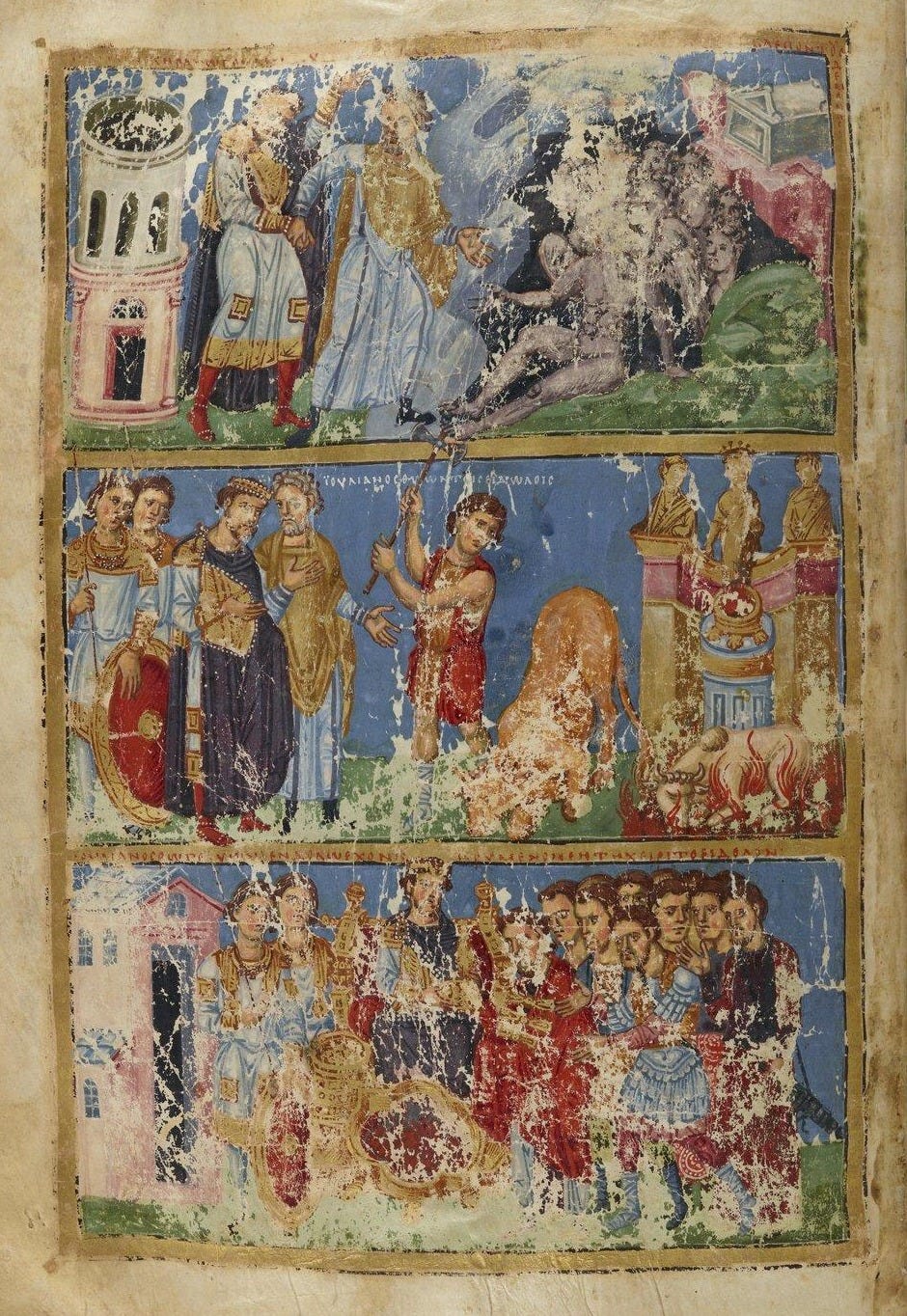
— “Julian arresting a bishop and ordering sacrifices to the Roman gods.” Source: Wikipedia.

Though separated by both doctrine and temperament, Philostorgius the Arian and John Chrysostom converge on a single, immutable point: the Divine Hand made itself unmistakably manifest at Jerusalem. Philostorgius supplies vivid corroboration in his Church History, opening with an observation that sets the tone (emphasis mine):
The Apostate thought that he would prove false our Savior’s prophecies that Jerusalem would be so completely overthrown that not even a stone would be left upon a stone; not only, however, did he not succeed in his attempt, but he even provided unshakeable, if involuntary, confirmation of what the prophecies contained. What he did was to gather the Jews from wherever they were, provide them with funds and other assistance from his own resources, and bid them restore the temple. But the terrors sent by God, which defy all description, not only snuffed their enthusiasm but reduced the Jews and him to utter helplessness and shame. What happened is that fire devoured those who were daring to set to work, an earthquake buried the site, and still other folk were cut to pieces in other accidents, so that the arrogance that had thought to bring shame upon the words of the Lord ended up by proclaiming, despite itself, how impossible it was to taint such venerable prophecies with any hint of shame. …
As we said earlier, Julian the Apostate sent orders to Jerusalem to rebuild the temple of the Jews that Vespasian and his son Titus had destroyed and burned together with the city, just as Christ the Lord had foretold concerning it to his disciples, bearers of God’s word: “Not a stone will remain upon a stone that will not be thrown down” The wicked man, then, in his desire to show that Christ's words were false, was above all anxious to rebuild the temple, and he ordered that the total cost of construction be paid from public funds. The God-killing Jews flocked together therefore and set to work with great joy and were excavating the foundation trench with silver mattocks and shovels and making ready to lay the foundations, when a terrific storm arose that buried the excavation site. All during that night it lightened and thundered ceaselessly, until finally as day was approaching there was an earthquake in which many perished even of those who had stayed out of doors. And a fire that came out of the excavated foundations incinerated everyone who was there. There were also cities that collapsed, Nicopolis, Neapolis, Eleutheropolis, Gaza, and many others. Not only that, but the colonnade by the Jewish synagogue in Aelia, that is to say, Jerusalem, fell down, killing many of those mentioned earlier, and fire burst forth mysteriously and incinerated a great many Jews. Darkness also fell upon these places, while continuous earthquakes caused great damage in many cities.
— Philostorgius, Church History (Book VII, §9)
He affirms the same general sequence as our other sources: labor began, the flames erupt, and the site is buried. Jerusalem, once the source of instruction to the nations, becomes so again, albeit, in judgement.
John Chrysostom, never one to mince words, makes the same point (emphasis mine)
For so even in our generation, in the instance of him who surpassed all in ungodliness, I mean Julian, many strange things happened. Thus when the Jews were attempting to raise up again the temple at Jerusalem, fire burst out from the foundations, and utterly hindered them all; and when both his treasurer, and his uncle and namesake, made the sacred vessels the subject of their open insolence, the one was “eaten with worms, and gave up the ghost,” the other “burst asunder in the midst.” Moreover, the fountains failing, when sacrifices were made there, and the entrance of the famine into the cities together with the emperor himself, was a very great sign. For it is usual with God to do such things; when evils are multiplied, and He sees His own people afflicted, and their adversaries greatly intoxicated with their dominion over them, then to display His own power…
— John Chrysostom, Homilies on Matthew (Homily IV, §2)
He alludes here to the sudden deaths of Julian, his treasurer, and his uncle — the latter by maladies and the Apostate from wounds suffered in battle. His most thorough accounting appears in his seminal homilies against Judaizing, Adversos Judaeos. Chrysostom notes how the Jews, forbidden by the Law from sacrificing outside the earthly Jerusalem, saw in Julian a chance to restore the beggarly elements of the Mosaic system (emphasis mine):
But what I am going to tell you is clear and obvious even to the very young. For it did not happen in the time of Hadrian or Constantine, but during our own lifetime, in the reign of the Emperor of twenty years ago. Julian, who surpassed all the emperors in irreligion, invited the Jews to sacrifice to idols…
They refused his invitation, but, at that time, they did admit to the very things I just lately proved to you, namely, that they were not allowed to offer their sacrifices outside Jerusalem. Their answer was that those who offered any sacrifice whatsoever in a foreign land were violating the Law. …
These abominable and shameless men had the impudence to ask these firings from an impious pagan and to invite him to rebuild their sanctuary with his polluted hands. They failed to see that they were attempting the impossible. They did not realize that if human hands had put an end to those things, then human hands could get them back for them. But it was God who destroyed their city, and no human power could ever change what God had decreed. “For what God, the Holy One, has planned who shall dissipate? His hand is stretched out; who will turn it back?” What God has reared up and wishes to remain, no man can tear down. In the same way, what he has destroyed and wishes to stay destroyed, no man can rebuild. …
The Emperor, for his part, spared no expense, sent engineers from all over the empire to oversee the work, summoned craftsmen from every land; he left nothing undone, nothing untried. …
They were just about to start building when suddenly fire leaped forth from the foundations and completely consumed not only a great number of the workmen but even the stones piled up there to support the structure. This put a stop to the untimely obstinacy of those who had undertaken the project. Many of the Jews, too, who had seen what had happened, were astonished and struck with shame. …
Even today, if you go into Jerusalem, you will see the bare foundation…
— John Chrysostom, Adversos Judaeos (Homily V, §XI.4-10)
To seek restoration by the hand of one who rejected Christ is to reject the very Cornerstone of the Temple.
We have, in this sampling alone, at least five extant ancient witnesses across theological lines and regions — all reporting nearly the same series of events. There are yet more we could refer to: Sozomen, Theodoret, Rufinus, even nods in Rabbinic tradition, but this handful should suffice to demonstrate the spectacular intervention that stopped the Apostate and his erstwhile allies in their tracks.
The ruins of the Temple became an object lesson, the stones crying out as eloquent proof of the New Covenant’s supremacy and the Old’s finality.
“2 Beware of dogs, beware of evil workers, beware of the concision [mutilation].
3 For we are the circumcision, which worship God in the spirit, and rejoice in Christ Jesus, and have no confidence in the flesh.”
― Epistle to the Philippians 3:2-3 KJV
In his subsequent homily, Chrysostom, a keen diagnostician of Israel’s spiritual pathologies, observes that all former Hebrew captivities — whether Egyptian, Babylonian, or Seleucid — were not only prophesied beforehand, but each was assigned a terminus. Their yet present exile, he notes, is of a different nature however (emphasis mine):
If the present captivity of the Jews were going to come to an end, the prophets would not have remained silent on this but would have foretold it. I gave adequate proof of this when I showed that all their bondages were brought upon them after they had been predicted: the bondage in Egypt, the bondage in Babylon, and the bondage in the time of Antiochus Epiphanes. I proved that for each of these the Sacred Scriptures had proclaimed beforehand both a time and a place. But no prophet defined a duration for the present bondage, although Daniel did predict that it would come, that it would bring total desolation, that it would change their old commonwealth and way of life, and how long after the return from Babylon it would come to pass.
But Daniel did not reveal that it would come to an end nor that these troubles would ever stop. Nor did any other prophet. Daniel did, however, predict the opposite, namely, that this bondage would hold them in slavery until the end of time. The great number of years which have come and gone since that day are witnesses to the truth of what he said. And the years have shown neither trace nor beginning of a change for the better, even though the Jews tried many times to rebuild their temple. Not once, not twice, but three times they tried. They tried ill the time of Hadrian, in the time of Constantine, and in the time of Julian. But each time they tried they were stopped. The first two times they were stopped by military force; later it was by the fire which leaped forth from the foundations and restrained them from their untimely obstinacy.
— John Chrysostom, Adversos Judaeos (Homily VI, §II.1-2)
Indeed, as we noted in the prior entry, Daniel speaks not of a second redemption but of a final desolation, an overturning of the old polity without reprieve. God had destroyed their Temple, and God would ensure it remains so.
This dovetails with Isaiah’s harrowing commission in chapter 6 of his prophecy. The prophet is told of the judicial hardening of Israel, and, when stunned by the severity of the charge, asks how long this hardening will persist (emphasis mine):
9 And he said, Go, and tell this people, Hear ye indeed, but understand not; and see ye indeed, but perceive not.
10 Make the heart of this people fat, and make their ears heavy, and shut their eyes; lest they see with their eyes, and hear with their ears, and understand with their heart, and convert, and be healed.
11 Then said I, Lord, how long? And he answered, Until the cities be wasted without inhabitant, and the houses without man, and the land be utterly desolate,
12 And the Lord have removed men far away, and there be a great forsaking in the midst of the land.
— The Book of Isaiah 6:9-12 KJV
The judicial blindness imposed in verse 10 is similarly tied to a timeline, a fact too often ignored by our Dispensational friends. Though fulfilled in a limited manner during Isaiah’s time, this dire prophetic warning would find its ultimate fulfillment in the generation of the Apostles. The Apostle John cites this same passage and applies it to the Jewish rejection of Christ during His ministry (emphasis mine):
39 Therefore they could not believe, because that Esaias said again,
40 He hath blinded their eyes, and hardened their heart; that they should not see with their eyes, nor understand with their heart, and be converted, and I should heal them.
41 These things said Esaias, when he saw his glory, and spake of him.
— The Gospel of John 12:39-41 KJV
That glory, it should be noted, is said to be that of YHWH’s in Isaiah, yet the Apostle applies it to Christ. The same Christ who predicted Judea’s desolation now stands as the fulfillment and judge of Isaiah’s oracle. That desolation was already underway in the first century, inaugurated by the Crucifixion and ultimately sealed in the destruction of Jerusalem in 70 A.D.
This is the crux of Chrysostom’s argument, and ours as well: the finality of the present judgment upon the Temple is not like the judgments of old. Since God has tore down their Temple, the very notion that mortal hands might raise it again is a delusion worthy of rebuke. For if it were merely disciplinary, a temporary punishment awaiting reconciliation, then the Prophets of old would have foretold its limits. Instead, what they foretold was its persistence: not in a return to the earthly Jerusalem, but in its obliteration. (It also bears repeating that we have already addressed objections raised by those who hold to a future conversion of ethnic Israel in previous works, see Should A Christian Be A Zionist?)
As we have discussed in previous essays on the subject, this is not an isolated thread. This same finality is echoed in John’s apocalyptic vision. In the letter to the Church at Philadelphia, Christ promises vindication to the Church — and identifies her as His true dwelling place (emphasis mine):
9 Behold, I will make them of the synagogue of Satan, which say they are Jews, and are not, but do lie; behold, I will make them to come and worship before thy feet, and to know that I have loved thee.
10 Because thou hast kept the word of my patience, I also will keep thee from the hour of temptation, which shall come upon all the world, to try them that dwell upon the earth.
11 Behold, I come quickly: hold that fast which thou hast, that no man take thy crown.
12 Him that overcometh will I make a pillar in the temple of my God, and he shall go no more out: and I will write upon him the name of my God, and the name of the city of my God, which is new Jerusalem, which cometh down out of heaven from my God: and I will write upon him my new name.
— Apocalypsis 3:9-12 KJV
Those who claim to be the covenant people of God whilst denying His Son are described in no uncertain terms: a synagogue not of God, but of Satan. In their place are those who finish the race, the faithful remnant of Judean and Gentile alike who are inscribed into the heavenly temple, the true third temple — the Church.
Isaiah spoke of this too, albeit, his vision was long before Patmos. In his rebuke of rebellious Israel, he foretells of a day when the name Israel will be a curse amongst the faithful (emphasis mine):
15 For ye shall leave your name for a loathing to my chosen, and the Lord shall destroy you: but my servants shall be called by a new name, …
17 For there shall be a new heaven and a new earth: and they shall not at all remember the former, neither shall they at all come into their mind.
18 But they shall find in her joy and exultation; for, behold, I make Jerusalem a rejoicing, and my people a joy.
— The Book of Isaiah 65:15, 17-18 BES
That new name is Christian. If the Lord is making a new Jerusalem, it definitionally can not be the old. If the things of the former world are “not remembered,” the eschatological Jerusalem of verse 18 cannot be the one which now lies in the Middle East.
The earthly city which once bore the name of the Divine is — like Saul before David — a rejected vessel.
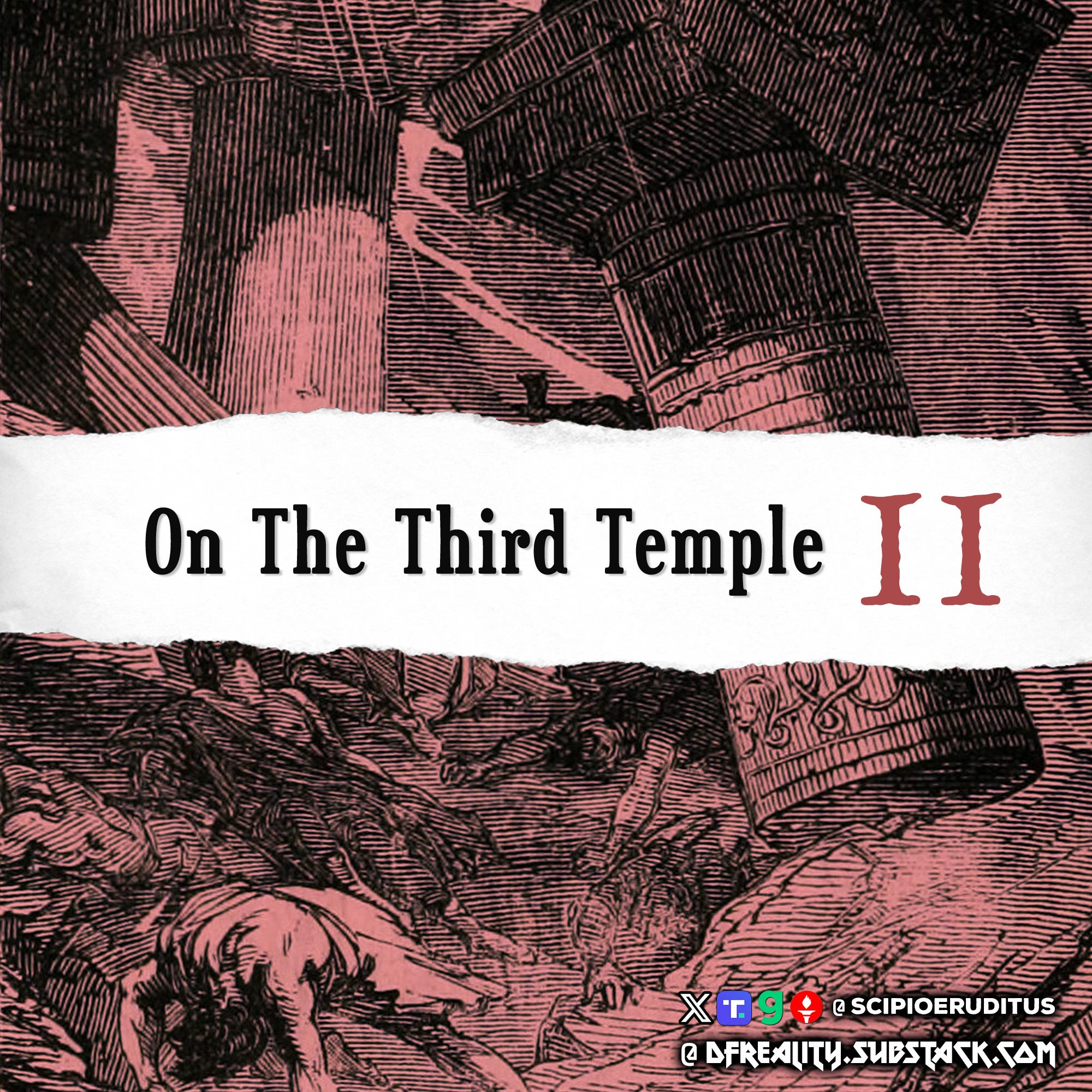
— The Cataclysm, digital art, 2026.
The final testimony of Scripture leaves little ambiguity whether the earthly Jerusalem has been abandoned in favor of a new, sanctified city for God’s people.
There is at least one point on which my futurist brethren and I can agree in regards to the carnal Jerusalem. The city that once housed the oracles of God is indeed the object of end times prophecy — only not for renewal, but rejection. It was not Titus who stripped her name from heaven’s roll, nor Hadrian, nor Julian, but the Almighty. What the prophets declared, history has confirmed with devastating force.
It is this judgment that Josephus, a reluctant chronicler, recorded with near prophetic insight. Surveying Jerusalem’s ruin after the Roman siege, he writes (emphasis mine):
Now as soon as the army had no more people to slay, or to plunder, because there remained none to be the objects of their fury: (for they would not have spared any, had there remained any other work to be done:) Cæsar gave orders that they should now demolish the intire city, and temple: but should leave as many of the towers standing as were of the greatest eminency, that is, Phasaelus, and Hippicus, and Mariamne: and so much of the wall as inclosed the city on the west side. This wall was spared, in order to afford a camp for such as were to lie in garrison: as were the towers also spared in order to demonstrate to posterity what kind of city it was, and how well fortified, which the Roman valour had subdued. But for all the rest of the wall, it was so thoroughly laid even with the ground, by those that dug it up to the foundation, that there was left nothing to make those that came thither believe it had ever been inhabited. This was the end which Jerusalem came to, by the madness of those that were for innovations.
— Flavius Josephus, Wars of the Jews (Book VII, Ch. 1.1)
A generation after the Apostles, when a false messiah led yet another Jewish revolt, Jerusalem was again devastated. This is what Isaiah had seen those many centuries prior: “Until the cities be wasted without inhabitant… and the land be utterly desolate.”
To revert our hopes to an earthly Jerusalem is to “seek the living among the dead.” It is no accident that the Apocalypse ends with the vision of New Jerusalem alone, radiant as a bride, with no temple. Ever since the Second Temple’s destruction in 70 A.D., every attempt to rebuild the old sanctuary has met with failure. It becomes evident, then, that the “Man of Sin” prophesied by Paul will not sit in any literal temple made with human hands. Dispensational interpreters fixate on Paul’s phrase as if it necessitates a brick-and-mortar building. But Paul – who consistently taught that believers themselves are God’s temple – was hardly mandating a return to the defunct Levitical sanctuary. The temple in which the Antichrist exalts himself must be understood in light of the New Testament’s overall revelation. The temple of 2nd Thessalonians is best seen as a counterfeit of the true temple: a usurpation of God’s throne in the spiritual realm, rather than the physical.
It is for this reason, as well as the historical witness previously discussed, that leads this author to firmly conclude that any attempt to build a “Third Temple” will fail in a similarly dramatic fashion: “God will not be mocked.”
Julian, for all his wickedness, at least grasped the nature of his struggle: the Christian Zionist, by contrast, blunders forward through theirs unawares. In the present day, the irony cuts deeper still. As Josephus records for us, the stones of the Wailing Wall are not at the site of Herod’s Temple. Instead, they press their foreheads, gyrate, and “spiritually copulate” at the western wall of Fort Antonia — the Roman garrison from which Titus launched the siege and oversaw the Temple’s final obliteration. The last visible remnant of the fortress that quartered the destroyers of the Temple has become, for many Rabbinic Jews, their holiest shrine.
It can not be said that God does not have a sense of humor.
“He that dwells in the heavens shall laugh them to scorn, and the Lord shall mock them.”
― Psalm 2:4 BES
Get Scipio’s latest book, The Empire of Lies: the American Empire unmasked.
Hit the Tip Jar and help spread the message!
This post contains affiliate links, which means I may receive a commission or affiliate fee for purchases made through these links.
Unlock the mysteries of Biblical cosmology and enrich your faith with some of the top rated Christian reads at BooksOnline.club.
Click the image below and be sure to use promo code SCIPIO for 10% off your order at HeavensHarvest.com: your one stop shop for emergency food, heirloom seeds and survival supplies.
Further Research
Adversos Judaeos by John Chrysostom
The Wars of the Jews by Flavius Josephus
Julian the Apostate by G.W. Bowersock

Know ye not that you are the temple of GOD, and that the Spirit of GOD dwelleth in you? 1Cor3:16 What? Know ye not that your body is the Temple of the Holy Ghost, which is in you, which ye have of GOD and ye are not your own? 1Cor6:19 But ye are not in the flesh, but in the Spirit, if so be that the Spirit of GOD dwell in you. Now if any man have not the Spirit of Christ, he is none of these. Rom8:9 Behold your house is left unto you desolate. Matt 23:38 Desolate means desolate. This proposed 3rd temple will not have a holy of holies. Why??? GOD will not be there. He is in all believers. This abomination will be inhabited by "whited sepulchers...full of dead men's bones." Thanks for the great job, Scipio.
this gives me shivers… is desecrating believers’ bodies their 3rd temple?