

On The Third Temple (Part I)
A house made without hands will never fall...

“Know ye not that ye are the temple of God, and that the Spirit of God dwelleth in you?”
— 1st Epistle to the Corinthians 3:16 KJV
Get Scipio’s latest book, The Empire of Lies: the American Empire unmasked.
Hit the Tip Jar and help spread the message!
This post contains affiliate links, which means I may receive a commission or affiliate fee for purchases made through these links.
Meet Scipio & get practical tools for wellness and preparedness at the Sovereign Health Summit — save 5% with promo code SCIPIO.

Unlock the mysteries of Biblical cosmology and enrich your faith with some of the top rated Christian reads at BooksOnline.club.
Click the image below and be sure to use promo code SCIPIO for 10% off your order at HeavensHarvest.com: your one stop shop for emergency food, heirloom seeds and survival supplies.

Related Entries


With events reaching a fever pitch in the Middle East, a deafening chorus within the Evangelical world is sounding the trumpet for the building of a Third Temple in Jerusalem.
Evangelical enthusiasm is deeply entwined with such efforts. In October 2024, for example, a replica of the Ark of the Covenant was triumphantly displayed in Jerusalem during the festival of Sukkot. In another instance, five unblemished red heifers were flown from Texas to Israel in 2022, courtesy of Christian Zionist donors and the American evangelical organization, Boneh Israel (Building Israel). Books, sermons, and End Times websites likewise fuel this fervor, teaching that every new headline about Jerusalem’s Temple Mount – from archaeological discoveries to geopolitical maneuvers – portends the rebuilding of “God’s house” in Israel. This modern zeal for a Third Temple is one of the most significant drivers of evangelical support for Israel: many now see it as their spiritual obligation to help pave the way for a rebuilt Temple (this despite also believing it will be inhabited by the “Antichrist.”)
Yet amidst this sea of excitement, a critical observer must ask: is this fervor theologically sound, or even justified? While one can certainly find such ideas promulgated by a distinct minority of theologians throughout Church history, the modern clamor for a Third Temple largely rests on a specific end-times theology. As we have discussed elsewhere, the insistence that a Third Temple must rise before Christ’s return is one of the core tenets of the prophetic schema of Dispensationalism, and, week after week, prophecy pundits point to current events to affirm said beliefs. What might seem to the outsider as an odd fixation is, to its adherents, a necessary precondition for the final act of God’s redemptive drama.
There is historical precedent for such yearnings, but it is not encouraging for our dispensational friends. In the fourth century, the Roman emperor Julian — nicknamed the Apostate for good reason — attempted to finance and oversee the rebuilding of a third temple. That attempt failed in dramatic and miraculous fashion, as we will explore in further detail in Part II.
The logic for this position, such as it is, often runs like this: there must be a third temple because the Antichrist must desecrate it. The Man of Sin cannot "sit in the temple of God, shewing himself that he is God," unless a temple exists for him to profane. And so Christian longing, perversely, becomes entangled with the architect of its abomination.
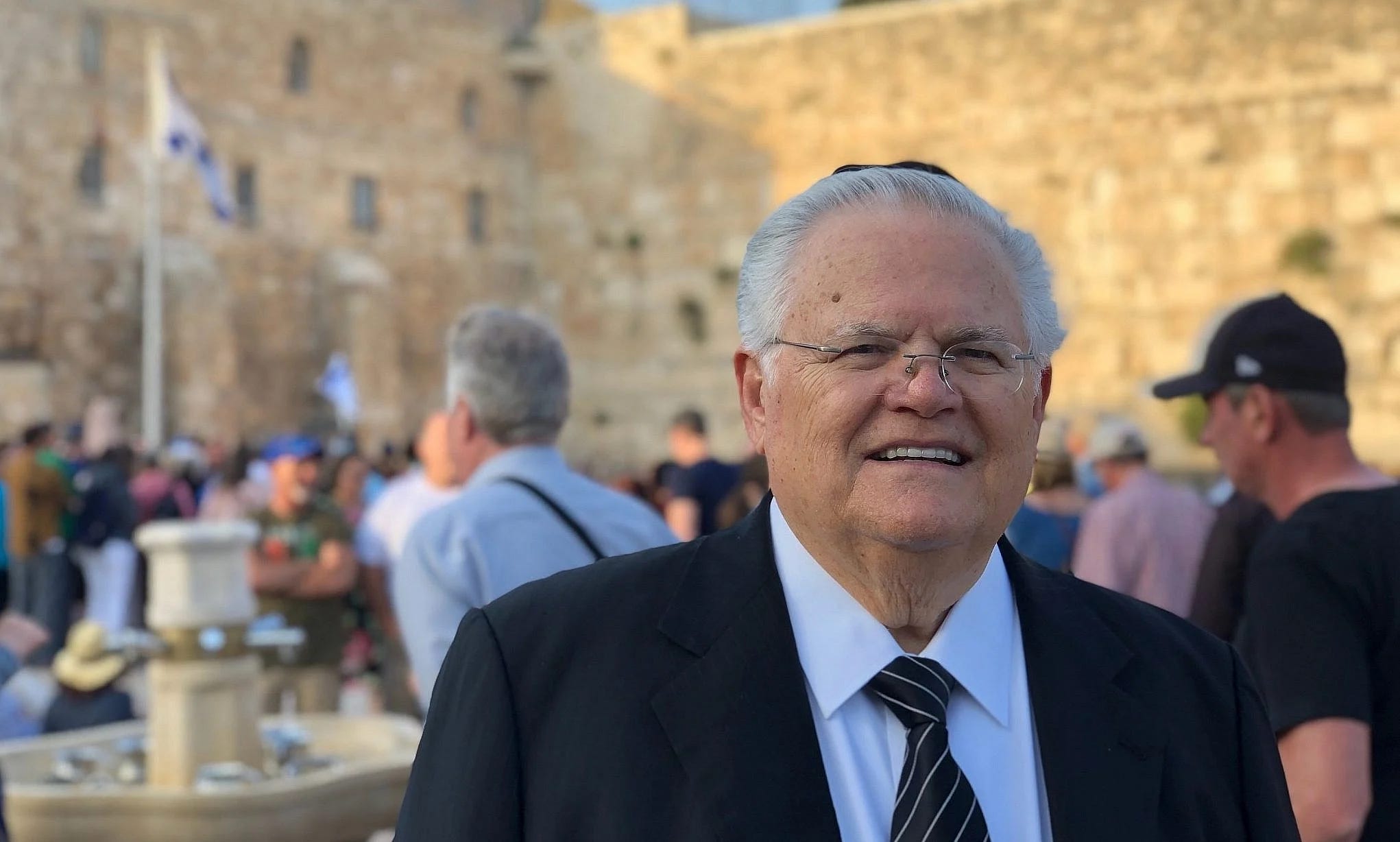
— John Hagee, a prominent Zionist, televangelist, and advocate for the building of the Third Temple, can be seen by the Wailing Wall.
“For in the last days the mountain of the Lord shall be glorious, and the house of God shall be on the top of the mountains, and it shall be exalted above the hills; and all nations shall come to it.”
— The Book of Isaiah 2:1 BES
What, then, are we to make of this persistent fascination with a third temple?
Why does its absence trouble so many, and why is its potential reconstruction hailed as good news?
The New Testament is strikingly silent on the matter — except, perhaps, to negate it. What does Scripture reveal concerning the place of God's dwelling in the last days? Christ’s words to the Samaritan woman (a Gentile, notably) are instructive: “The hour cometh, when ye shall neither in this mountain, nor yet at Jerusalem, worship the Father” (John 4:21). Writing to Gentile believers, Paul declares (emphasis mine):
19 Now therefore ye are no more strangers and foreigners, but fellowcitizens with the saints, and of the household of God;
20 And are built upon the foundation of the apostles and prophets, Jesus Christ himself being the chief corner stone;
21 In whom all the building fitly framed together groweth unto an holy temple in the Lord:
22 In whom ye also are builded together for an habitation of God through the Spirit.
— Epistle to the Ephesians 2:19-22 KJV
Here the household of God (the Church) is explicitly described as both a holy temple and a nation. This living Temple is still under construction, but it is already the dwelling of God’s Spirit. No more does God’s presence condescend to a man-made building of wood and stone — it is The Church, composed of Judeans and Gentiles reconciled in one Body, that is God’s new Temple.
The Apostle Peter uses the very same imagery (emphasis mine):
5 Ye also, as lively stones, are built up a spiritual house, an holy priesthood, to offer up spiritual sacrifices, acceptable to God by Jesus Christ.
6 Wherefore also it is contained in the scripture, Behold, I lay in Sion a chief corner stone, elect, precious: and he that believeth on him shall not be confounded.
7 Unto you therefore which believe he is precious…
9 But ye are a chosen generation, a royal priesthood, an holy nation, a peculiar people; that ye should shew forth the praises of him who hath called you out of darkness into his marvellous light;
10 Which in time past were not a people, but are now the people of God: which had not obtained mercy, but now have obtained mercy.
— 1st Epistle of Peter 2:5-7, 9-10 KJV
In this rich passage, Peter mixes temple and priesthood metaphors freely. Believers are the stones of the new Temple and simultaneously the priests serving in it. God is still worshipped with sacrifice under the New Covenant, albeit our sacrifices are no longer the blood of bulls and goats, but the “spiritual sacrifices” of praise and holy deeds (Rom. 12:1, Heb. 13:15-16). Notice too how Peter deliberately takes language once used for Israel alone (“a holy nation, a peculiar people”) and applies it to the Body of Christ. The implications are momentous: the Church is the continuation, nay, the fulfillment of Israel.
The promise of God dwelling amongst His people is fulfilled not in a rebuilt Jewish temple, but in a worldwide community of believers stretching through space and time. Lest one think this a New Testament novelty, the seeds of this truth are found liberally spread throughout the Old Testament, a small survey of which we will explore. The prophets foresaw a time when God’s dwelling and kingdom would expand far beyond the bounds of one city or one building. Daniel, interpreting King Nebuchadnezzar’s dream, prophesied of the coming Kingdom of God that would eclipse and replace all Earthly kingdoms (emphasis mine):
38 Thou sawest until a stone was cut out of a mountain without hands, and it smote the image upon its feet of iron and earthenware, and utterly reduced them to powder.
44 And in the days of those kings the God of heaven shall set up a kingdom which shall never be destroyed: and his kingdom shall not be left to another people, but it shall beat to pieces and grind to powder all other kingdoms, and it shall stand for ever.
45 Whereas thou sawest that a stone was cut out of a mountain without hands, and it beat to pieces the earthenware, the iron, the brass, the silver, the gold; the great God has made known to the king what must happen hereafter: and the dream is true, and the interpretation thereof sure.
— The Book of Daniel 2:38, 44-45 BES
That phrase “without hands” is a Biblical idiom for something not of human manufacture but of God’s own doing (Mark 14:58). The stone grows into a mountain that fills the whole earth. What is this except the Kingdom of Christ, i.e. His Church? Indeed, the stone that the builders rejected has become the cornerstone of that true Temple and Kingdom (Ps. 118:22, Matt. 21:42-44).
The prophet Micah (quoting from Isaiah) likewise foresaw the days when the Lord’s house would transcend its old physical boundaries (emphasis mine):
1 And at the last days the mountain of the Lord shall be manifest, established on the tops of the mountains, and it shall be exalted above the hills; and the peoples shall hasten to it.
2 And many nations shall go, and say, Come, let us go up to the mountain of the Lord, and to the house of the God of Jacob; and they shall shew us his way, and we will walk in his paths: for out of Sion shall go forth a law, and the word of the Lord from Jerusalem.
— The Book of Micah 4:1-2 BES
In these “last days” (which refers to Christ’s first advent, as we will shortly demonstrate), the Word of the Lord has indeed gone forth from Jerusalem to all the nations. Peoples of every tongue have flowed into the Lord’s House by joining His Church. Far from pointing us to an earthly, future temple, Micah’s prophecy finds its magnificent fulfillment in the Church and ultimately in the perfected Kingdom, where “the LORD shall reign over them in mount Zion from henceforth, even for ever” (v. 7 KJV). Similarly, consider Psalm 87 (BES), a passage in which Sion — “the city of God,” (v. 3) a city which has its “foundations … in the holy mountains” (v. 1) — is built by God Himself (v. 5) and inhabited by Canaanites, Babylonians, Philistines, Tyrians, and Ethiopians (v. 4). By contrast, any proposed Third Temple built by human hands would be a house not founded by God, and thus of no more significance than any other pile of bricks.
On the Day of Pentecost, the Apostle Peter confirms that the last-days kingdom foretold by the prophets had already begun. As the Holy Spirit descended upon the disciples, Peter declared (emphasis mine):
16 But this is that which was spoken by the prophet Joel;
17 And it shall come to pass in the last days, saith God, I will pour out of my Spirit upon all flesh: and your sons and your daughters shall prophesy, and your young men shall see visions, and your old men shall dream dreams:
— The Book of Acts 2:16-17 KJV
There are many such passages we could draw from in the New Testament to further expound upon this point, and have in other essays, but this will be sufficient for our purposes. No greater honor could be given to the Church than to be the vessel of God’s own Spirit on Earth: if the Spirit is in us, we have no need to seek Him in a rebuilt Holy of Holies in Jerusalem.
In the Gospel of John, on the great feast day in Jerusalem, Jesus stood in the Temple courts and cried out: “He that believeth on me, as the scripture hath said, out of his belly shall flow rivers of living water... this spake he of the Spirit” (John 7:38-39a KJV) What a striking image: in the Messianic age, living water was expected to flow from the threshold of the Temple (as pictured in Ezekiel 47 and Zechariah 14): “And in that day living water shall come forth out of Jerusalem; half of it toward the former sea, and half of it toward the latter sea: and so shall it be in summer and spring.” (Zech. 14:8 BES) That this river would flow in both the wet and dry season, as well as continuing to flow despite crossing the River Jordan, should be an indication that the aforementioned river is not a natural one. It should be noted again that Jesus applies this prophecy not to a physical city, but to the individual believer – “out of his belly” (his innermost being) shall flow the life-giving waters of the Spirit. In doing so, Christ identifies the true Tabernacle as the heart of the faithful.
In this author’s estimation, those who insist on a literal, future fulfillment of such prophecies drastically miss the point. The point is that God’s life-giving presence would emanate from Jerusalem to the whole world – and in the New Testament that is exactly what has happened, through the Church. We are the citizens of the Heavenly Jerusalem, and from within us the Holy Spirit flows forth in evangelism, in works of mercy, in holy living – a river of life to a dead world. So too did Jeremiah rebuke the apostates of old: “For my people have committed two evils; they have forsaken me the fountain of living waters, and hewed them out cisterns, broken cisterns, that can hold no water.” (Jer. 2:13 KJV) To dig for water in the dust of a rebuilt altar in Jerusalem would be to abandon the living spring already welling up to eternal life (John 4:14).
When the New Testament looks to the culmination of history, it does not describe believers rebuilding an old temple. On the contrary, in the final vision of Revelation, St. John beholds the Holy City, New Jerusalem, in the perfected new creation – and pointedly notes: “I saw no temple therein: for the Lord God Almighty and the Lamb are the temple of it” (Rev. 21:22 KJV).
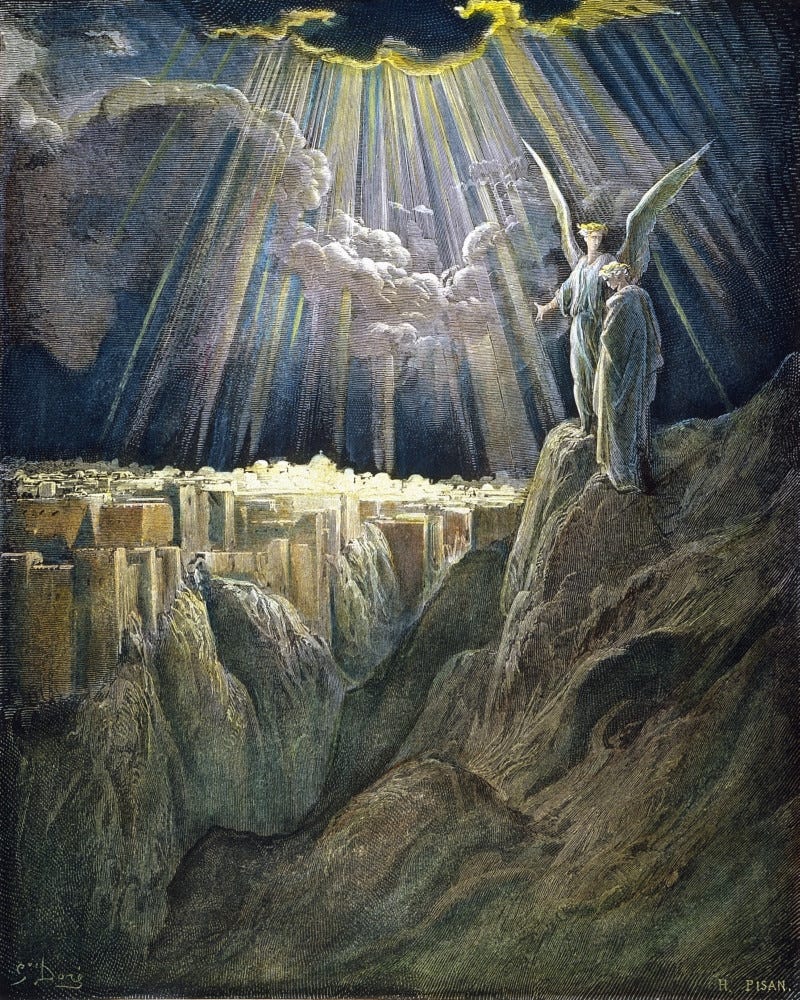
— The New Jerusalem, ill. by Gustave Doré.
Throughout the New Testament, the inspired authors consistently point us away from earthly shadows and toward present heavenly realities in Christ. Nowhere do they encourage believers to anticipate a return to the old Temple worship. On the contrary, they warn that clinging to the external rites of the Mosaic age is a regression from the glory of Christ. Stephen, the first martyr, declared boldly before the Sanhedrin that “the Most High dwelleth not in temples made with hands” (Acts 7:48 KJV), and he was echoing Solomon and Isaiah before him. Paul reminded the Athenians that God “needeth not” temples (Acts 17:24-25 KJV). The first Christians understood that the earthly temple in Jerusalem was a concession – a divine condescension – to accommodate human longing for a tangible place to meet God. The temple, then, was a temporary pedagogical symbol – a shadow of something far greater to come.
The Hebrew prophets foretold that the task of building God’s true temple would belong not to any group of earthly masons or apostate religious leaders, but to the Messiah Himself. Zechariah proclaims (emphasis mine):
12 and thou shalt say to him, Thus saith the Lord Almighty; Behold the man whose name is The Branch; and he shall spring up from his stem, and build the house of the Lord.
13 And he shall receive power, and shall sit and rule upon his throne; and there shall be a priest on his right hand, and a peaceable counsel shall be between them both.
— The Book of Zechariah 6:12-13 BES
Here we see a prophecy that a Davidic scion (the Branch) will construct YHWH’s house and rule upon a throne – combining both kingly and priestly roles. As we have already covered at length in The Quick & The Dead, that figure is undoubtedly Christ. Notably, this prophecy was given after the return from the Babylonian exile, when a second temple (the temple of Zerubbabel & Herod) was already being built. Thus, Zechariah was not referring to the post-exilic project per se, but to a greater, eschatological temple built by the Messiah. Indeed, Jesus declared “I will build my church” (Matt. 16:18 KJV), as only the Messiah has the authority to raise up God’s eternal sanctuary – any attempt by others to erect a temple for God’s presence is by definition profane.
The ancient prophets often spoke of Mount Zion and Jerusalem in exalted terms, envisioning a time when God’s reign and fellowship with His people would be perfected on that holy mountain. Abraham’s eyes were set beyond Canaan: “he looked for a city which hath foundations, whose builder and maker is God” (Heb. 11:10 KJV). This expectation was shared by the Patriarchs: “But now they desire a better country, that is, an heavenly: wherefore God is not ashamed to be called their God: for he hath prepared for them a city.” (Heb. 11:16 KJV) One of the crucial insights of the New Testament is that these prophetic images find their fulfillment not in a plot of land in the Middle East, but in the spiritual reality of the Church. The Epistle to the Hebrews makes this even more plain (emphasis mine):
22 But ye are come unto mount Sion, and unto the city of the living God, the heavenly Jerusalem, and to an innumerable company of angels,
23 To the general assembly and church of the firstborn, which are written in heaven, and to God the Judge of all, and to the spirits of just men made perfect,
24 And to Jesus the mediator of the new covenant, and to the blood of sprinkling, that speaketh better things than that of Abel.
— Epistle to the Hebrews 12:22-24 KJV
In Paul’s allegory of the two Jerusalems, he likewise identifies the mother-city of believers, one currently in existence, as the supra-terrestrial one: “Jerusalem which is above is free, which is the mother of us all.” (Gal. 4:26 KJV)
Far from awaiting a physical ascent to an earthly mountain, Christians already have access to the heavenly Mount Zion — through Christ.
“And when ye shall see Jerusalem compassed with armies, then know that the desolation thereof is nigh.”
― The Gospel of Luke 21:20 KJV
At this point we turn to address objections from Dispensationalist and futurist exegetes who will still insist on a future rebuilding of an earthly temple as part of God’s plan.
It is essential to note that both Scripture and history stand firmly against such notions. The prophet Daniel, in the verse that Jesus quotes regarding Jerusalem’s fate (Matt. 24:15), foretold a devastating desolation decreed for the temple. The Septuagint (which I am using in the more colloquial sense to refer to the Greek Old Testament widely used by the early Church) renders Daniel 9:27 with striking finality: “…on the temple the abomination of desolations; and at the end of time an end shall be put to the desolation.” (Dan. 9:27 LXX) In other words, the desolation of Jerusalem’s sanctuary would last until the very end – until the consummation of the ages. There is no hint here of the desolation being lifted a few decades, centuries, or millennia later to allow a new temple. Early Christian writers understood this as a permanent judgment on the Old Temple system, and it is this prophecy that the Emperor Julian would attempt to overthrow in the fourth century.
Furthermore, Jesus pronounces a sentence of desolation on the earthly Jerusalem for its unbelief. Standing in the Temple courts just days before His crucifixion, our Lord laments over the holy city (emphasis mine):
37 O Jerusalem, Jerusalem, thou that killest the prophets, and stonest them which are sent unto thee, how often would I have gathered thy children together, even as a hen gathereth her chickens under her wings, and ye would not!
38 Behold, your house is left unto you desolate.
39 For I say unto you, Ye shall not see me henceforth, till ye shall say, Blessed is he that cometh in the name of the Lord.
— The Gospel of Matthew 23:37-39 KJV
Jerusalem’s fate was inexorably tied to their acceptance of Him. The house – which can only refer to the Temple – was now their house, not God’s, and would remain desolate.
Any temple erected while ethnic Israel persists in their rejection of Christ would be, at best, a house of their own making – one devoid of God’s glory, just as the Second Temple was, as documented by Rabbinic sources:
This represents five, the numerological value of heh, phenomena that constituted the difference between the First Temple and the Second Temple, in that they were not in the Second Temple. And these are: The Ark of the Covenant, and the Ark cover upon it, and the cherubs that were on the Ark cover; fire; and the Divine Presence; and the Divine Spirit; and the Urim VeTummim. Apparently, there was no fire from heaven in the Second Temple. The Sages say in response: Yes, there was fire from heaven in the Second Temple; however, it did not assist in burning the offerings but was merely visible above the wood.
It for this reason that “many of the priests and Levites and chief of the fathers, who were ancient men, that had seen the first house, when the foundation of this house was laid before their eyes, wept with a loud voice” (Ezra 3:12 KJV).
One might ask: if a new temple is not in God’s ultimate plan, why do some Old Testament prophecies (like Ezekiel’s visionary temple in Chapters 40-48) describe a future house of God? The answer lies in understanding the conditional nature of prophecy. In the case of Ezekiel’s temple vision, a careful reading shows God likewise put a condition on its fulfillment. After describing the plan of a glorious new sanctuary, God charged Ezekiel: “Thou, son of man, shew the house to the house of Israel, that they may be ashamed of their iniquities: … And if they be ashamed of all that they have done, shew them the form of the house, and the fashion thereof… and all the laws thereof… that they may keep the whole form thereof” (Ezk. 43:10-11 KJV). The conditional nature of prophecy means that unfulfilled temple prophecies pose no challenge to God’s faithfulness; rather, they underscore human failure to repent and the redirection of God’s promises to a faithful remnant in a different (often superior) form. As Jesus told the Judean leaders of His day: “The kingdom of God shall be taken from you, and given to a nation bringing forth the fruits thereof” (Matt. 21:43 KJV).
Through Jeremiah, the Lord explains this principle: “And at what instant I shall speak concerning a nation, and concerning a kingdom, to build and to plant it; If it do evil in my sight, that it obey not my voice, then I will repent of the good, wherewith I said I would benefit them.” (Jer. 18:9-10 KJV) This point is often lost on our Dispensational friends, namely, that even the promises made to Abraham were conditional. In Genesis 18, the Lord deliberates, “Shall I hide from Abraham that thing which I do…?” — i.e. the judgment of Sodom. Why not hide it? Because, the Lord says, “Abraham shall surely become a great and mighty nation… for I know him, that he will command his children… to do justice and judgment; that the Lord may bring upon Abraham that which he hath spoken of him.” (v. 17–19 KJV). The fulfillment of the promise was conditioned on Abraham teaching his household to walk in the ways of the Lord. At Nineveh, Jonah declared unconditional doom in forty days, yet when the people repented in sackcloth, God repented of their judgement.
The word of prophecy is true — but it is also one that is responsive to repentance.
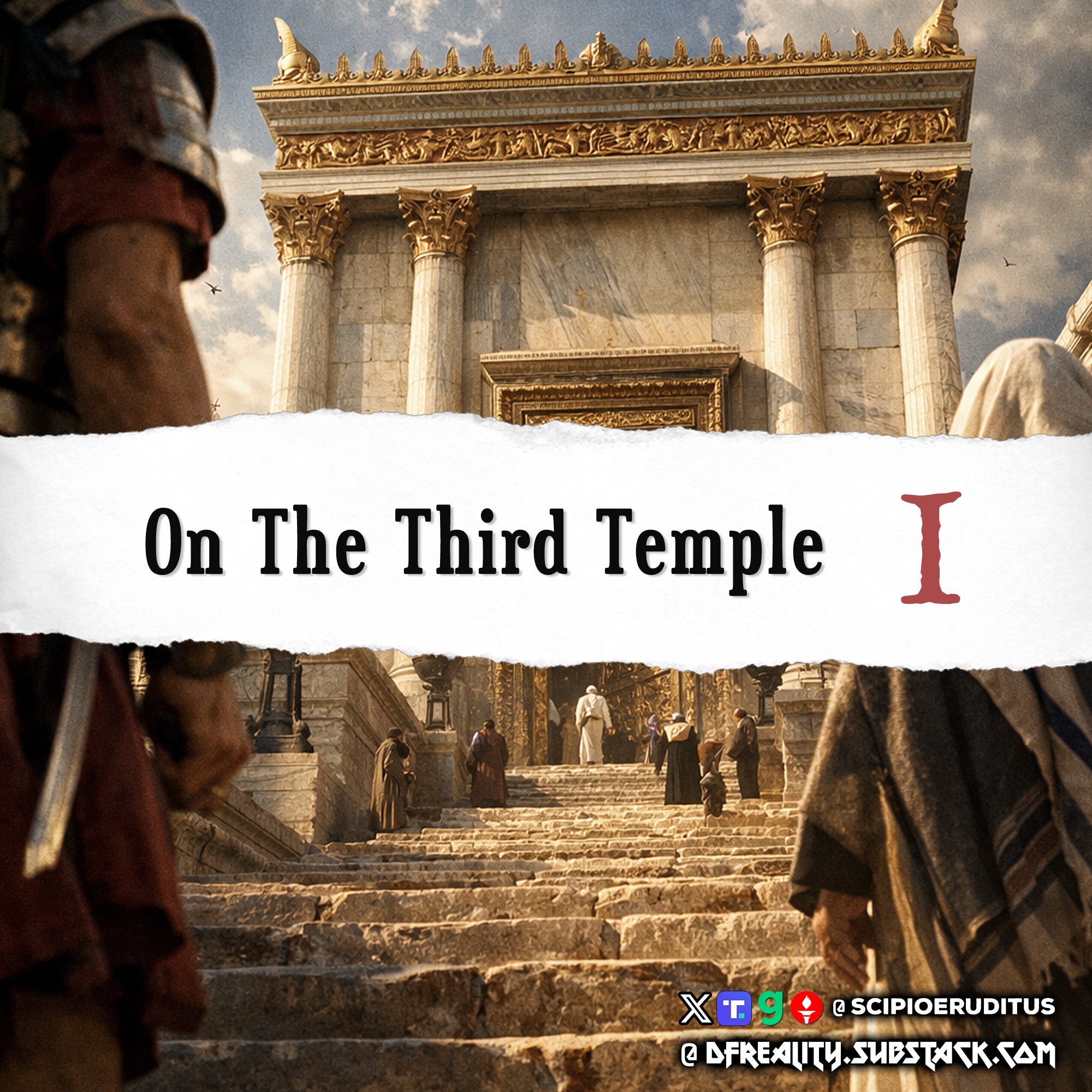
— The Temple, digital art, 2026.
All that the temple foreshadowed – God’s dwelling with man, a holy priesthood, a final sacrifice for sin, the outpouring of the Divine Presence – has been fulfilled once and for all in Christ Jesus and His Church. The Third Temple that obsessively occupies the minds of modern prophecy enthusiasts is, in truth, already here — just not at all in the form they expect. It is a Temple “not made with hands,” an eternal house in the Heavens, one whose construction began when Christ rose from the dead and became its chief cornerstone.
Yet, despite the solemn clarity of Scripture and the unbroken testimony of the Apostles, there have always been those who imagined they could reverse God's verdict. Just as ancient Israel turned back toward Egypt in her heart, so too have men looked longingly to the ruins of the Temple, hoping to resurrect what God Himself has razed.
History does not lack for such attempts.
In the fourth century, amidst the rising sun of Christendom, a single man dared to defy that divine edict. The Roman Emperor Julian believed he could undo what Christ had accomplished, and, with full imperial backing, sought to rebuild the Jewish Temple.
He would fail.
Concluded in Part II…
“But it was God who destroyed their city, and no human power could ever change what God had decreed.”
― John Chrysostom, Adversos Judaeos (Homily V, §XI.6)
Get Scipio’s latest book, The Empire of Lies: the American Empire unmasked.
Hit the Tip Jar and help spread the message!
This post contains affiliate links, which means I may receive a commission or affiliate fee for purchases made through these links.
Meet Scipio & get practical tools for wellness and preparedness at the Sovereign Health Summit — save 5% with promo code SCIPIO.
Unlock the mysteries of Biblical cosmology and enrich your faith with some of the top rated Christian reads at BooksOnline.club.
Click the image below and be sure to use promo code SCIPIO for 10% off your order at HeavensHarvest.com: your one stop shop for emergency food, heirloom seeds and survival supplies.
Further Research
A City Lost (2025) — Documentary
The Temple and the Church’s Mission: A Biblical Theology of the Dwelling Place of God by Gregory K. Beale

Last Days Madness: Obsession of the Modern Church by Gary DeMar

Against Our Better Judgement: The hidden history of how the U.S. was used to create Israel by Alison Weir

Rapture Fever: Why Dispensationalism is Paralyzed by Dr. Gary North
When Christian people believe lies about the truth that is the Word of God they parabolically become the 3rd temple which is inhabited by agents of Satan himself thus partially fulfilling 2 Thessalonians 2 1-12. Of special importance is the fact that it is God himself who sends the strong delusion.
Christian Zionists today in congress are Zionist idolators and war mongers making it obvious that their faith is contrary to scripture. John Hagee claims there are 50 million strong ready to fight for Israel. I believe we are in Satans little season (started in late 1700’s) and that the hardcore of this bunch is the falling away and the false prophet that gives its power to the beast. The beast (Pharaseeism) that received a mortal head wound but lived on.
I pray that we may save some of them.
The sacrifice was done away with when YESHUA sacrificed Himself to pay the death penalty for our sins. In reading about their desire for a "3rd" temple it is to have 3 worship areas..muslem, christian and jewish...since evidently they haven't read their Bible nor believe that YESHUA has already come and there is no more sacrifice, why would anyone support this. The people that occupy the state of Israel are not the people of the covenant nor do they follow GOD the FATHER nor abide by HIS law. Hagie is one of the worst