

Contra Monas
If all is one then all is none...

“First let us clearly understand the position of monism: As manifested beings we appear to be separate, but our reality is one, and the less we think of ourselves as separate from that One, the better for us.”
— Vivekananda, Hindu Philosopher & Yogi (1863-1902)
The Wolves Within is a must-read for every believer who refuses to be deceived.
Hit the Tip Jar and help spread the message!
This post contains affiliate links, which means I may receive a commission or affiliate fee for purchases made through these links.
Unlock the mysteries of Biblical cosmology and enrich your faith with some of the top rated Christian reads at BooksOnline.club.
Click the image below and be sure to use promo code SCIPIO for 10% off your order at HeavensHarvest.com: your one stop shop for emergency food, heirloom seeds and survival supplies.

Related Entries


Monism is the philosophy that all of reality is fundamentally one substance, whether that be God or Prima Materia, and that all distinctions we perceive — between things, between the self and the world, or even between truth and error — are illusions.
Philosophy ultimately begins with the problem of difference. We experience a world full of distinctions: subject and object, thought and thinker, true and false, good and evil, self and other. Any worldview worth holding must account for these distinctions without collapsing into contradiction. To begin with the premise that all is One ends with the inability to assert anything meaningful. Yet for over two millennia, various monistic traditions — Eastern and Western alike — have attempted to deny the real existence of difference. Whether in its Eastern forms such as Hinduism & Buddhism, or its Western manifestations such as Neoplatonism & Materialism, the claim is the same: all is one, and distinctions are illusion.
We first turn to the oldest form of this philosophy: Eastern monism — specifically, the systems of Shankara and Nagarjuna. Adi Shankara, the principal expositor of the Advaita Vedanta school of thought, taught that all apparent multiplicity is illusion (maya): the only true reality is Brahman — pure, undifferentiated consciousness. According to Shankara, the individual self (jiva) is not ontologically distinct from Brahman. The apparent difference is only due to ignorance (avidya), and liberation consists in realizing the identity of ātman and Brahman — “Thou art that.” Or in other words, “ye shall be like Gods.” (Gen. 3:5)
He writes:
This Absolute Oneness alone is Real since there is nothing other than the Self. Truly, there is no other independent entity in the state of full realization of the supreme Truth.
— Vivekachudamani, v. 226
But this metaphysical denial of duality or difference collapses under basic scrutiny. If all distinctions are illusory, then so is the distinction between illusion and reality. Shankara claims Brahman is real and the world is maya. But if distinction is itself illusion, then the assertion “Brahman is real, the world is false” is also false.
Moreover, if the individual self is unreal, who is it exactly that is ignorant? And who is it that attains liberation? If the ego is an illusion, then the one who experiences bondage or enlightenment never actually existed. Shankara wants to say that the illusion ends in the realization of truth, but he must first presuppose a subject capable of being deceived and then enlightened — two states he denies are real!
Consider this vicious circularity:
The world is an illusion.
This illusion ends when the self realizes it is Brahman.
But the self, the realization, and even the idea of illusion are all illusions.
The analogy commonly offered is that of the rope mistaken for a snake: when realization occurs, one sees the rope as it is. But for this analogy to work, the rope must be real. If the rope too is an illusion, the entire structure collapses. Thus, if we are to grant that all is Brahman, then this absolutely simple metaphysical principal must necessarily be both enlightened and ignorant simultaneously. Shankara affirms a distinction in order to deny all distinctions — a textbook case of self-refutation.
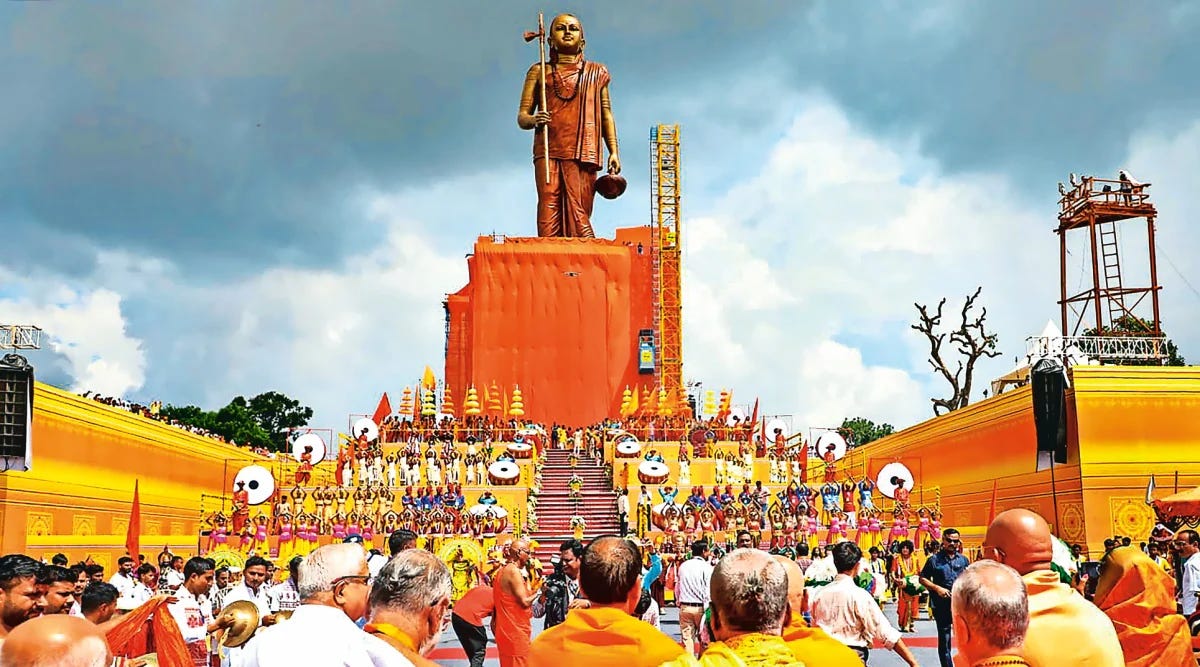
— “The 108 feet tall statue of Hindu saint Adi Shankaracharya, named 'Ekatmata Ki Pratima' (Statue of Oneness), during its unveiling ceremony, at Omkareshwar in Khandwa district, Madhya Pradesh. (PTI Photo)”. Source: Indian Express.
While Shankara tried to preserve a stable monistic reality behind illusion, Nagarjuna, the founder of Madhyamaka Buddhism, goes further: he denies any reality whatsoever. For Nagarjuna, not only is the self empty, but all phenomena — objects, thoughts, causes, categories — are devoid of inherent existence (svabhāva). What remains is a system that dissolves ontology into pure relation and denies any real universals — a metaphysical position indistinguishable from Nominalism. Nagarjuna’s śūnyatā, or emptiness, is not Eastern profundity — it is premodern anti-realism, elevated to religious status.
In his Mulamadhyamakakarika, Nagarjuna writes:
The life-process has no thing that distinguishes it from freedom. Freedom has no thing that distinguishes it from the life-process. Whatever is the extremity of freedom and the extremity of the life-process, between them not even a subtle something is evident.
— Mulamadhyamakakarika of Nagarjuna: The Philosophy of the Middle Way, Ch. 25.19-20
And again:
Why? - Because it is devoid of an intrinsic nature. Those things which are dependently originated are not, indeed, endowed with an intrinsic nature; for they have no intrinsic nature - why? Because they are dependent on causes and conditions.
— Ch. 15.1
His strategy is not to construct a metaphysical system, but to negate all systems — including his own. Using a fourfold logic (neither is, nor is not, nor both, nor neither), Nagarjuna attempts to show that every proposition collapses into contradiction. The goal is not to assert a truth but to deconstruct the illusion that truth and falsity are meaningful.
But this too is self-defeating. If all statements are devoid of substance, so is the statement that “all statements are devoid of substance.” If truth is impossible, then so too is the claim that truth is impossible. Nagarjuna cannot even assert his own emptiness thesis without presupposing the logical distinction between assertion and denial. He saw the trap and tried to embrace it, claiming that even emptiness is empty. But if that were so, there is no reason to accept his philosophy — or anything else. The result is epistemological and moral nihilism: there is no way to distinguish illusion from enlightenment, good from evil, or delusion from realization.
As the Lankavatara Sutra later admitted (ironically), “If all things are illusion, then enlightenment itself is an illusion.”
“You can only apprehend the Infinite by a faculty that is superior to reason.”
― Plotinus, Greek Philosopher (204–270 AD)
Amongst Western philosophers who advanced monistic metaphysics, Plotinus looms large. As the progenitor of Neoplatonism, he promulgated a philosophical tradition built upon Plato’s notions of absolute unity. Plotinus distilled Platonic thought into an elaborate metaphysical hierarchy, placing at its pinnacle a transcendent, indivisible principle he called simply “The One.” This supreme principle, he maintained, is entirely beyond description, thought, and even being itself. Yet in advocating for this Absolute, Plotinus’s philosophy collapses under the weight of its internal contradictions — contradictions that emerge clearly in his own words.
Plotinus describes The One explicitly as something entirely beyond human cognition or description. In the Enneads, he states:
Thus The One is in truth beyond all statement: any affirmation is of a thing; but the all-transcending, resting above even the most august divine Mind, possesses alone of all true being, and is not a thing among things; we can give it no name because that would imply predication: we can but try to indicate, in our own feeble way, something concerning it…
— Enneads, III.13
Immediately, Plotinus exposes the fundamental contradiction at the heart of his philosophy: in asserting that The One is “unspeakable” and “indescribable,” he nonetheless admits, paradoxically, that “we speak and write of it.” By Plotinus’s own admission, his philosophy is caught in the very act of violating its foundational rule. He goes on to assert that any true knowledge of The One is not gained through rational or empirical means, but through ecstatic and mystical forms of supra-rational gnosis — a mystical union in which even the distinction between knower and known dissolves.
This contradiction intensifies when Plotinus attempts logical argumentation to establish the existence of The One. He argues that rational thought necessarily leads to the conclusion of an ultimate, undivided source of reality. Plotinus asserts:
Standing before all things, there must exist a Simplex, differing from all its sequel, self-gathered not inter-blended with the forms that rise from it, and yet able in some mode of its own to be present to those others: it must be authentically a unity, not merely something elaborated into unity and so in reality no more than unity's counterfeit; it will debar all telling and knowing except that it maybe described as transcending Being- for if there were nothing outside all alliance and compromise, nothing authentically one, there would be no Source. Untouched by multiplicity, it will be wholly self-sufficing, an absolute First, whereas any not-first demands its earlier, and any non-simplex needs the simplicities within itself as the very foundations of its composite existence.
— Enneads, III.4
Yet, logical argumentation itself depends fundamentally upon distinctions — between premises and conclusions, causes and effects, true and false propositions. If The One truly transcends all distinctions, then logic itself is inapplicable. Plotinus acknowledges the tension but does not seek resolve it rationally. Thus, his philosophical project undercuts its own legitimacy from the outset, as it attempts to establish through rational distinction something defined explicitly as being beyond all rational distinctions.
Further contradictions arise in Plotinus’s theory of emanation — the notion that reality proceeds involuntarily from the One, descending through hierarchical stages of reality. Plotinus describes this process vividly:
The One is all things and none of them… From such a unity as this, everything flows forth…
— Enneads V.2
But here Plotinus again entangles himself: if the One is absolutely perfect, lacking nothing, why must it necessarily emanate anything at all? If emanation is truly involuntary, then the One seems subject to some internal necessity or deficiency — a scenario Plotinus explicitly denies. Yet if truly sufficient and complete, it should produce nothing beyond itself.
Plotinus never reconciles this stark inconsistency.
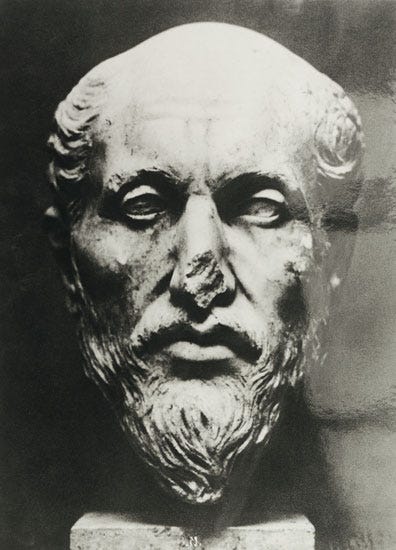
— Bust of Plotinus.
The problem of evil and imperfection further compounds these issues. Plotinus argues that evil arises as mere privation or absence of good, describing matter as the lowest rung of reality and associating it with imperfection and deficiency: Matter is evil because it is the “privation of good”, and, as such, is “absolute poverty.” (Enneads I.8.3)
But if matter and imperfection inevitably emanate from The One, then Plotinus unintentionally identifies the One itself as the ultimate source of privation and imperfection — a conclusion contradicting his own assertion of absolute divine perfection. Furthermore, by admitting to the reality of matter, it logically follows that evil has some sense of reality as well. Athanasius the Confessor notes this issue:
Now certain of the Greeks, having erred from the right way, and not having known Christ, have ascribed to evil a substantive and independent existence. In this they make a double mistake: either in denying the Creator to be maker of all things, if evil had an independent subsistence and being of its own; or again, if they mean that He is maker of all things, they will of necessity admit Him to be maker of evil also. For evil, according to them, is included among existing things. But this must appear paradoxical and impossible. For evil does not come from good, nor is it in, or the result of, good, since in that case it would not be good, being mixed in its nature or a cause of evil.
— Against the Heathen, I.6
Despite his attempts to relegate evil merely to privation, Plotinus cannot convincingly dissociate the highest good from responsibility for deficiency, as all things ultimately emanate from it.
Epistemologically, Plotinus’s philosophy also fails to sustain coherence. He defines the ultimate state of knowledge as mystical union with The One, describing it as a state in which all distinctions vanish entirely. Yet the possibility of knowledge presupposes clear distinctions — most fundamentally, between the knower and the known. Plotinus’s ultimate state of realization thus annihilates the very conditions that make knowledge possible. In describing union as the absence of distinction, Plotinus inadvertently identifies ultimate enlightenment as indistinguishable from epistemological darkness — true knowledge as indistinct from total ignorance.
One may reasonably object that Christianity, like Plotinus, understands evil primarily as a privation of good rather than as an independent, metaphysical substance. Augustine famously argues precisely this point, stating in his Confessions that evil "is nothing but the removal of good until finally no good remains" (Confessions, III.7). Given this similarity, might Christianity not face the same criticism we’ve leveled at Plotinus — namely, that God is ultimately responsible for the existence of evil?
Yet there is a crucial difference between the Christian account and the Neoplatonic one. Plotinus’s One emanates reality involuntarily and necessarily. There is no genuine metaphysical gap between the ultimate principle and the cosmos. Because the cosmos inevitably flows forth from The One, every aspect of the universe — including privation and imperfection — can ultimately be traced directly back to The One itself. Thus, in Plotinus’s system, the supreme principle bears direct metaphysical responsibility for evil, even if he calls that evil merely "privation."
Christianity, by contrast, insists upon a fundamental ontological distinction between Creator and creation. God does not involuntarily emanate reality; rather, He freely creates rational, moral agents distinct from Himself, each endowed with genuine free will: free in the sense not that it is free of all outside influences upon it, but that it is truly free to choose otherwise. Thus, in the Christian worldview, Evil arises not from God’s nature but from the misuse of this created freedom. Augustine explains (emphasis mine):
If human beings lacked free choice of the will, how could there be the good in accordance with which justice itself is praised in condemning sins and honoring right deeds? For what does not come about through the will would neither be sinning nor acting rightly. Consequently, penalty and reward would be unjust if human beings did not have free will. There ought to be justice in punishment and in reward, since justice is one of the goods that are from God. Hence God ought to have given free will to human beings.
Thus, while evil is indeed a privation of good in both frameworks, Christianity’s affirmation of genuine creaturely freedom creates a clear ontological and moral boundary between God and evil.
Evil is not a product of God’s being or nature; it arises from our choices (emphasis mine):
13 Let no man say when he is tempted, I am tempted of God: for God cannot be tempted with evil, neither tempteth he any man:
14 But every man is tempted, when he is drawn away of his own lust, and enticed.
15 Then when lust hath conceived, it bringeth forth sin: and sin, when it is finished, bringeth forth death.
— The Epistle of James 1:13-15 KJV
Or as Ecclesiasticus states (emphasis mine):
11 Say not thou, It is through the Lord that I fell away: for thou oughtest not to do the things that he hateth.
12 Say not thou, He hath caused me to err: for he hath no need of the sinful man.
13 The Lord hateth all abomination; and they that fear God love it not.
14 He himself made man from the beginning, and left him in the hand of his counsel;
15 If thou wilt, to keep the commandments, and to perform acceptable faithfulness.
— Sirach 15:11-15 LXX
God’s decision to grant autonomy to His creation ensures that He is neither the cause nor the involuntary source of privation. The responsibility for evil rests with creatures who freely reject the good — not with their Creator who freely granted their existence and endowed them with said free will. In this way, Christianity avoids the contradiction inherent in Neoplatonic monism. Plotinus, by positing an involuntary, necessary emanation from The One, cannot escape implicating his supreme principle in evil.
Ultimately, Plotinus’s elegant philosophical edifice proves untenable, collapsing under its own logic. Its contradictions are not peripheral but fundamental, undermining the very basis of rational discourse and knowledge. In the end, Neoplatonism proves no more successful than its Eastern counterparts, trapped in the philosophical impossibility of its own making.
“You can do what you decide to do — but you cannot decide what you will decide to do.”
— Sam Harris, Athiest Philosopher (Free Will, Pg. 38)
Finally, we must consider Materialism, evaluating whether this contemporary philosophical tradition succeeds in avoiding the contradictions that plagued ancient monists, both Eastern and Western.
Unlike the metaphysical abstractions of Eastern mystics or Plotinus’ transcendent One, Materialism — itself a modern form of Monism — asserts bluntly that matter-energy alone constitutes reality: everything is reducible entirely to physical processes. Central to Materialism is the explicit claim that consciousness, free will, and personal identity are illusions or epiphenomena — mere byproducts of brain activity. Daniel Dennett, for instance, openly argues against the reality of subjective consciousness as traditionally understood, stating:
Human consciousness is itself a huge complex of memes (or more exactly, meme-effects in brains).
Dennett thereby reduces subjective experience — the very medium through which we access reality — to a mechanical output of neurological events. Similarly, neuroscientist and philosopher Sam Harris argues explicitly against the reality of free will in his eponymously named book. In making such claims, materialistic monists insist that what we experience as agency or consciousness is fundamentally an illusion — merely a neurological narrative generated by deterministic brain chemistry.
Yet here the contradictions quickly become apparent. Dennett and Harris rely precisely upon consciousness, agency, and rational choice to present arguments designed to persuade readers of their point of view. To argue against consciousness or free will presupposes that readers can consciously and rationally evaluate the argument, weigh evidence, and choose to accept or reject conclusions. If consciousness and choice are mere illusions, there can be no meaningful rational evaluation at all — only predetermined neurological responses. Their philosophical stance thus undermines the rational basis of their own arguments.
Furthermore, Materialism undermines the rational foundations necessary for “the science” that Harris and his ilk continually preen about. Science relies upon the meaningful distinction between true and false beliefs. But as Alvin Plantinga famously argued in his Evolutionary Argument Against Naturalism:
If my mental processes are determined wholly by the motions of atoms in my brain, I have no reason to suppose that my beliefs are true... and hence I have no reason for believing my brain to be composed of atoms.
Materialism thus undercuts its own epistemological basis. By reducing rationality itself to predetermined neurological responses, it removes the grounds upon which science — and indeed any rational discourse — stands.
Finally, and most destructively, Materialism destroys the possibility of objective morality. Dennett acknowledges this explicitly: “There is no good and evil in any absolute sense… morality is an evolved human construct.” (Dennett, Darwin's Dangerous Idea, Pg. 496) Yet Dennett and Harris, despite explicitly denying objective morality, engage vigorously in moral judgments and ethical debates, particularly against belief systems which they deem “harmful” or “irrational.” Their own moralizing rhetoric thus betrays their stated philosophy.
They constantly use moral language to denounce what they claim does not truly exist — an objective moral order — thereby contradicting themselves at every turn.

— Monas, digital art, 2025.
The project of Monism, whether garbed in Eastern mysticism, Neoplatonic abstraction, or the sterile jargon of neuroscience, is the same: a denial of difference. It aims to erase the very idea of knowledge, relation, and morality by collapsing all things into a single metaphysical substance — whether that be Brahman, the One, or matter itself. Monism demands that we unsee creation, unspeak truth, and unthink ourselves. It is not a philosophy that describes reality — it is a philosophical lobotomy.
What all three monistic systems share is their allergy to particularity. The self must vanish. The world must be denied. Evil must be dismissed as illusion. Rationality must be replaced by mystical absorption, involuntary procession, or neurological compulsion. But in so doing, these systems destroy the very grounds on which they make their claims. They assert the ineffable. They argue against argument. They moralize against morality. In the end, each form of Monism becomes a snake devouring its own tail.
Only Christian metaphysics survives this inspection. Why? Because it begins with what the others attempt to erase: real distinction. God is not the cosmos. He is not a principle. He is not a process. He is a personal, rational, volitional Being who creates other beings distinct from Himself, capable of reason, agency, and love. The Heavens and the Earth are not emanations; they are artifacts of divine will. Human nature is not a mirage or an evolutionary fluke — it is the imago Dei, the image of a rational Creator. And that Creator, far from demanding the annihilation of creation, condescended to enter into it.
The problem for Monists is not merely theological or abstract — it is epistemological. If there are no real distinctions, then knowledge is impossible. If subject and object collapse into one undifferentiated field, then perception, thought, and communication are all illusions. But if knowledge is impossible, then so is the claim that all is one.
Monism, in any form, refutes itself: if all is one, then all is none.
Christian metaphysics, by contrast, begins with a real Creator who is distinct from His creation, yet who made the world intelligible, orderly, and rational, because it reflects His own Wisdom. “Through faith we understand that the worlds were framed by the word of God” (Heb. 11:3). Where the world says, “You are God,” Christ says, “I AM HE.” And in that sentence is preserved every truth worth knowing: the difference between Creator and creature, between self and Savior, between good and evil, between existence and annihilation. Christianity not only affirms these distinctions — it explains their origin and necessity.
Monism, in its myriad manifestations, is not merely wrong at the periphery — it is wrong at the root. If taken seriously, this philosophy eliminates the possibility of knowledge, ethics, personality, and language — all whilst utilizing those very things it can not justify and claims to transcend.
Thus, their philosophical posturing is parasitic as they deny what they cannot do without.
“One day, doubtless, their terrible condemnation will be the greater for all this worldly wisdom, since, seeing so clearly into vain sciences, they have wilfully shut their eyes to the knowledge of the truth… these men, I say, have discovered all except one thing: the fact that God is the Creator of the universe, and the just Judge who rewards all the actions of life according to their merit.”
― Basil of Caeserea, Hexaemeron (Homily 1)
The Wolves Within is a must-read for every believer who refuses to be deceived.
Hit the Tip Jar and help spread the message!
This post contains affiliate links, which means I may receive a commission or affiliate fee for purchases made through these links.
Unlock the mysteries of Biblical cosmology and enrich your faith with some of the top rated Christian reads at BooksOnline.club.
Click the image below and be sure to use promo code SCIPIO for 10% off your order at HeavensHarvest.com: your one stop shop for emergency food, heirloom seeds and survival supplies.
Further Research

Awesome post! The ambition of natural man wants to drown out all inputs except his own. This is very much in line with the five "I wills" of Satan.
The five "I wills" of Satan are described in Isaiah 14 and are often interpreted as his declaration of rebellion against God. These declarations are:
1. I will ascend into heaven: Satan declared his intention to rise to the highest place, indicating his desire to be equal to God.
2. I will exalt my throne above the stars of God: This shows his ambition to surpass the angels and rule over them.
3. I will sit also upon the mount of the congregation, in the sides of the north: Here, Satan expressed his desire to rule over the earth and its people.
4. I will ascend above the heights of the clouds: This indicates his wish to be seen as the supreme being, above all earthly and heavenly powers.
5. I will be like the Most High: This final declaration shows his ultimate goal of being worshiped as God himself.
These statements reflect Satan's pride and his desire to usurp God's authority, leading to his fall from heaven.
After the fall of man in Eden the human condition descended into a state where the beast nature was more prominent. Pastor Chuck Missler describes the four dimensions we call reality vs. the ten or more dimensions that we actually live in. All dimensions are required to keep the beast nature in check.
The problem is that these extended dimensions were commandeered by Satan in Eden when he set himself up as the god of this world. He re-made Adam in his own image, which is why Zeus (the re-made Adam) is depicted as a serpent man, showing how he was now possessed by Satan's ambition and self-deception. Cain then experiences this new fallen state in Genesis 4:7.
Chuck Missler's video is here, https://www.youtube.com/watch?v=vjiXgwmxunk
The Bible, particularly in Jeremiah 17, describes the human heart as "deceitful above all things and desperately wicked".
This passage highlights the inherent corruption and deceitfulness within human nature, emphasizing that the heart, which represents the whole being or person, is deeply flawed.
Love the ending quote! Well said! Now, if they all would just stick to the Bible....the ONLY true source of divine Wisdom. OUR GOD REIGNS! HALLELUJAH!
Wow, Scipio...thank you a bundle. The Lord always leads to answers we ask, in His Word, and/or through those who have researched more thoroughly and shared. Just yesterday, I received this reply from darkness is falling, to my comment, which I am sharing, because just now I received your article with the explanation that I knew nothing about...Monism. Gobbledygook to me, and I didn't understand a lot of the philosophical junk they spew...but got a lot of laughs at the futility of it, and how you showed the truth and how it cancels itself out. ha ha. Just very sad (and many tears and prayers) that so many are drawn to it, and make shipwreck of their souls by it. My first thought was that God would have them in derision and confusion. That's what it sounds like to me, and the way you explained it. Because they retained not a love of the truth, whereby they may be saved (memory only, not exact). And rejected the SIMPLICITY that is in the Word of God. For all that mystical nonsense and forbidden knowledge. You presented it in a way that might be able to reach those steeped in it though. They traded the truth for a lie. And pursued philosophy which goes hand in hand with vain deceit...or should I say produces vain deceit, and whereby they can never come a knowledge of the truth. So God has given them over to DELUSION.
Trying to thank you for helping me understand what happened to my Sister and so many millions of others...that's playing a huge part in the falling away from the faith. Bless you, and will continue to pray for your safety and continuance in sharing the real truths. And praying that some may find their way back to the faith they once held, while there is still time to do so. Return to their first love. My Sister now calls me stupid for not wanting to believe in her newfound "wisdom" and knowledge, and "enlightenment", which is really endarkenment that she can't recognize, and for believing in the Bible, as she once did. Very sad, but all prophesied to happen. William of darknessisfalling has helped a lot also, and I am grateful for all true watchmen and brethren in the family of God. Praise God from whom all blessings flow!
Jesus Is Lord
What made me wonder about my Sister, when she changed overnight to become, with UTTER EXUBERANCE...'ONE WITH THE UNIVERSE!!!" is...what happened in the night to turn her against the Lord, and become one with the universe...or, probably...ONE World (dis)Order. To this day, she says she never took the Covie Vexine, because, as she put it just recently...it disattaches you from your spirituality, or something like that. (false spirituality) Now she worships and is led by Sananda and a bunch of other "ascended masters" and says god is the evil one, and poor olde satan is the good one. The changes in her were sickening to see. I can only think that maybe she got a vex during one of her surgeries, or, a surgery she had while in the Air Force. but that one night changed her suddenly and completely. Like I've seen others change after a surgery, even minor ones. In Job is says, "They are taken in the night." There was one more huge change after they sent her to a closed military base nearby for two weeks as a guard...and I feel something was done to her there also. Our Father was dying, and they would not let her come home earlier. I guess we won't know fully until "Farther along, we'll know all about it, farther along we'll understand why." Except knowing that the vex takes them away also, and what a change it makes! If I hadn't seen it happen in several people, I might not have believed it before. Thank you again for such in depth analyses and sharing the real truths. May the Lord bless you abundantly....I love that hymn. More abundantly, more abundantly, that we might have life, and more abundantly....the devil makes them think they will have life more abundantly too...biggest liar there ever was. I told my Sister...You will wish you had believed me.
19 hours ago
@DarknessIsFalling
Hi Crystal! Thank you again for sharing! Your sister is a Gnostic. It's amazing how many people have believed this old LIE! God is evil, Jesus was NOT "Flesh" (because flesh is evil) and MAN can "ascend" by his good works to become one (Saved) by the great Monad (Spirit) or LIGHT, which is Satan. There's no doubt that the TESTS and INJECTIONS have "Transformed" people. I see it everywhere. Covid technology Transforms AND KILLS! Whatever happened to your sister, they definitely GOT to her somehow. It's a tragedy and i sense your pain. God bless you!