


“For my part, I would much rather that you would furnish us with a translation of the Greek version of the canonical Scriptures known as the work of the Seventy translators. For if your translation begins to be more generally read in many churches, it will be a grievous thing that, in the reading of Scripture, differences must arise between the Latin Churches and the Greek Churches …”
— St. Augustine of Hippo, Letter to Jerome (c. 403 AD)
Get Scipio’s latest book, The Empire of Lies: the American Empire unmasked.
Hit the Tip Jar and help spread the message!
This post contains affiliate links, which means I may receive a commission or affiliate fee for purchases made through these links.
Meet Scipio & get practical tools for wellness and preparedness at the Sovereign Health Summit — save 5% with promo code SCIPIO.

Unlock the mysteries of Biblical cosmology and enrich your faith with some of the top rated Christian reads at BooksOnline.club.
Click the image below and be sure to use promo code SCIPIO for 10% off your order at HeavensHarvest.com: your one stop shop for emergency food, heirloom seeds and survival supplies.

Related Entries


Amongst the most revealing exchanges in the history of the LXX controversy is the correspondence between St. Augustine and St. Jerome concerning the latter’s then-new Latin translation of the OT.
Jerome had undertaken what was, by any measure, a monumental scholarly endeavor. Dissatisfied with the many corrupt and conflicting Old Latin translations then circulating in the West, he turned increasingly to the Hebrew manuscripts available to him and sought to produce a Latin OT corrected according to what he considered the original “Hebrew truth.” Writing a decade before this, Jerome was exploring the very issue we have been exploring here — namely, whether the rabbis had corrupted the Hebrew text (emphasis mine):
There are two reasons for the shortness of this letter, one that its bearer is impatient to start, and the other that I am too busy to waste time on trifles. You ask what business can be so urgent as to stop me from a chat on paper. Let me tell you, then, that for some time past I have been comparing Aquila's version of the Old Testament with the scrolls of the Hebrew, to see if from hatred to Christ the synagogue has changed the text; and — to speak frankly to a friend — I have found several variations which confirm our faith.
— Letter 32 (c. 384 AD)
In practice, Jerome’s study of Hebrew and his access to Hebrew manuscripts depended heavily upon Jewish teachers and the textual tradition preserved within the synagogue. Though he remains one of the staunchest critics of Jewish textual corruption in the early Church, St. Jerome relied on the synagogue text under the premise that the Hebrew, being the mother tongue of the Prophets, naturally represented the most authentic textual stream. Therefore, in matters of textual dispute, the Hebrew was to take precedence unless some compelling evidence dictated otherwise.
There is certainly a force and logic to this argument that makes it compelling upon initial examination, but we find it does not hold up to scrutiny. Certainly, we would not contest that the oracles of God were first delivered to the Hebrews (though when St. Paul states this, it is beyond dispute that he had the LXX in view.) That the synagogue text of Rabbinic Judaism best represents that “pure” stream of truth rather than the Greek is largely just assumed — this despite the mountain of Patristic and NT citations militating against such an idea. Whether that presupposition is justified is precisely the issue in question.
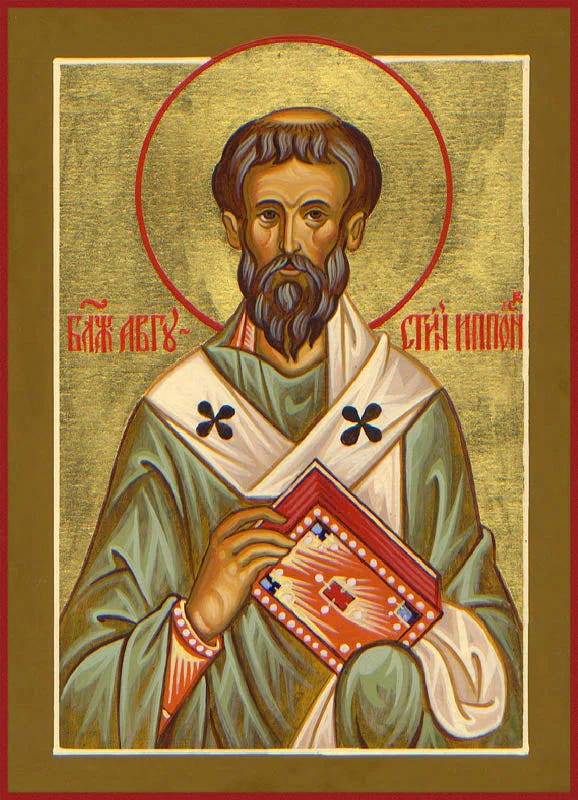
— Byzantine icon of St. Augustine of Hippo.
Nearly twelve centuries before the Reformation, St. Augustine of Hippo recognized the tensions St. Jerome’s translation project might introduce into the Western Church. Writing to Jerome around 394 AD, Augustine pleaded with him (emphasis mine):
I beseech you not to devote your labour to the work of translating into Latin the sacred canonical books, unless you follow the method in which you have translated Job, viz. with the addition of notes, to let it be seen plainly what differences there are between this version of yours and that of the Septuagint, whose authority is worthy of highest esteem. For my own part, I cannot sufficiently express my wonder that anything should at this date be found in the Hebrew manuscripts which escaped so many translators perfectly acquainted with the language. I say nothing of the Seventy, regarding whose harmony in mind and spirit, surpassing that which is found in even one man, I dare not in any way pronounce a decided opinion, except that in my judgment, beyond question, very high authority must in this work of translation be conceded to them.
— Letter to Jerome (c. 394 AD)
Nine years later, the concern expressed in his initial correspondence had matured into the warning placed at the head of this chapter. The Scriptures supply the language of doctrine, and wherever the Greek and Hebrew traditions differ, the churches which receive them will eventually differ in the arguments they draw from them. Augustine feared that the general adoption of Jerome’s translation would create differences in the public reading of Scriptures: his apprehension was remarkably prescient. The Orthodox Church has continued to use the LXX for the last two millennia, while the Latin West gradually adopted an OT increasingly governed by the Hebrew manuscripts, an impulse which would culminate in the MT’s wholesale adoption by the Protestant Reformers.
We have already discussed this problem in relation to Psalm 22 and Isaiah 7, both significant Messianic passages. In each instance, the LXX preserves the reading upon which the Apostolic interpretation rests, while the competing Hebrew tradition weakens the force of the prophecy. That the LXX represents the faithful rendering of these passages is nearly universally recognized by Christian translators of all creedal and doctrinal varieties. There are many more examples, the most unimpeachable of which will be examined in this chapter. Where one text speaks plainly, another may obscure; where one supplies the premise of an Apostolic argument, another may leave the argument appearing unsupported. Though outside the scope of our present study, the fullness of those divergences, as foreseen by St. Augustine, would indeed prove to be significant.
The earliest major divergence between the LXX and the later MT appears in the opening chapters of Genesis, and the difference is measured in millennia.
“Most ancient Christian scholars argued for the originality of the LXX’s primeval chronology. This strong consensus lasted for over 14 centuries until the Reformation, when the MT supplanted the primacy of the LXX in the western church.”
— Henry B. Smith Jr., Methuselah’s Begetting Age in Genesis 5:25 and the Primeval Chronology of the Septuagint: A Closer Look at the Textual and Historical Evidence (Answers Research Journal 10, 2017)
Genesis 5 and 11 are not genealogies in the loose sense sometimes encountered elsewhere in Scripture or the ancient Near East. Each generation is accompanied by the age of the Patriarch when he begat his son, the number of years he lived afterwards, and his total lifespan: the figures are cumulative by design. Whatever one ultimately concludes about the precise date of Creation, the text plainly intends to supply a continuous chronology from Adam to Abraham, as it was universally understood by both the Jews and the early Church.
The difficulty is that the LXX and MT do not have the same one.
The accompanying table, reproduced from S. Douglas Woodward’s Rebooting the Bible, Part I, records the begetting ages supplied in Genesis 5 and 11 by the MT and LXX. The divergence is too regular to be explained by accident:
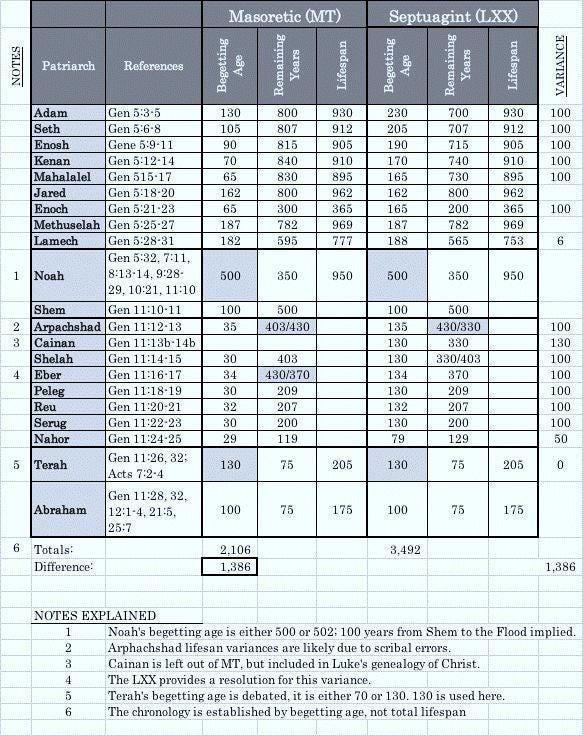
— Fig. 23, from Rebooting the Bible, Part 1.
According to the LXX, Adam, Seth, Enosh, Kenan, Mahalalel, and Enoch each begat the next Patriarch one hundred years later than the MT records, and the pattern resumes after the Flood. In most cases, the total lifespan remains exactly the same; the missing century has simply been transferred from the Patriarch’s begetting age to the years he is said to have lived afterwards. Repeated across two genealogies, the result is staggering however — a difference of 1,386 years. Woodward attributes this alteration directly to Rabbi Akiva and the supposed Council of Jamnia. I agree with the substance of his argument far more than its historical precision. As demonstrated in the previous chapter, there is little reason to believe in a formal council which gathered to settle the “rabbinic canon” — a canon, mind you, which would remain in flux for another century.
While the Samaritan Pentateuch preserves a sharply different antediluvian chronology, and thus is not conclusive in settling this disagreement, from the Flood to Abraham its begetting ages agree with the LXX almost exactly. Josephus supplies yet another witness as he gives Adam’s age at the birth of Seth as 230, precisely as the LXX does. His post-Flood genealogy likewise preserves the higher begetting ages. Josephus differs from the LXX in certain particulars, and the numerical totals transmitted in his text are not entirely consistent. Nevertheless, the tradition before him was plainly not the compressed chronology later preserved by the MT, and is yet another area where Josephus demonstrates a preference for the LXX tradition over the later rabbinic one.
This agreement is of considerable importance since the higher figures can not be dismissed as a chronological expansion invented by the Seventy. They were known to Josephus and preserved by the schismatic Samaritans centuries before the medieval Masoretic text. Eusebius, St. Augustine of Hippo, St. Julian of Toledo, Jacob of Edessa, George Syncellus, and Bar Hebraeus all note the dispute, and several expressly charge the Jewish scribes with shortening the Patriarch’s ages to diminish Messianic expectancy. According to the longer chronology received by the early Church, Christ appeared after approximately five and a half millennia of history, within the sixth millennium traditionally associated with the coming of the Messiah. That expectation loses its force if the chronology is pushed back over a thousand years.
For our case, the genealogy of St. Luke presents the decisive evidence. In tracing the ancestry of Christ beyond Abraham and Noah, the Evangelist writes:
Which was the son of Sala, which was the son of Cainan, which was the son of Arphaxad, which was the son of Sem, which was the son of Noe …
— The Gospel of Luke 3:35–36 KJV
The LXX of Genesis 11 preserves that same order, while the MT omits the second Cainan in Shem’s lineage. On this particular point, Josephus and the Samaritan Pentateuch offer us no support, as both likewise omit him. St. Luke does not however, and as an Apostle he quite obviously holds far more bearing on what constitutes the authoritative translation of the text for the Church. It can not be understated that the genealogy of Christ as preserved in the Gospel agrees with the LXX and contains a Patriarch absent from the MT. Luke will primarily draw from the LXX for his Scriptural citations throughout his corpus, namely his Gospel account and the Acts of the Apostles.
One may debate how the name was lost from one tradition or possibly entered another, but for the Christian reader, one is left two options: either St. Luke supplies us an incorrect lineage of Christ as recorded in the LXX, or we must question the supposed “purity” of the rabbinic text — one which they even admit the “sages” tampered with.
“Search the scriptures; for in them ye think ye have eternal life: and they are they which testify of me.”
— The Gospel of John 5:39 KJV
The selection of verses we will be examining is partially indebted to S. Douglas Woodward’s treatment in Rebooting the Bible, Part I, though its arrangement and several of its examples arise from my own comparison of the NT, the LXX (specifically Sir Brenton’s English Septuagint), and the MT. The examples chosen here are those I regard as incontestable: passages in which the wording of the NT agrees precisely with the LXX. In each instance, the Apostolic accounts identify the OT reading received by Christ and His blessed Apostles as the one preserved by the Seventy. For the Christian, that witness takes precedence. This selection is only the tip of a vast iceberg.
These divergences fall into three broad and frequently overlapping classes: prophecies identifying the Messiah, prophecies announcing the reuniting of the Gentiles in the covenant of YHWH, and prophetic indictments directed against the rulers & teachers of Israel — or against the Judean people more generally. The concentration is remarkable. I have previously described the Talmudic traditions concerning Christ, examined by Peter Schäfer in Jesus in the Talmud, as an anti-Gospel. The rabbis were not ignorant of the Christian claims and answered them with counter-narratives of their own. The Talmud emerged, in substantial part, within that anti-Christian controversy.
The readings absent or substantially altered in the later Hebrew text repeatedly concern Christ, the nations gathered to Him, and the judgment pronounced upon those who reject both.
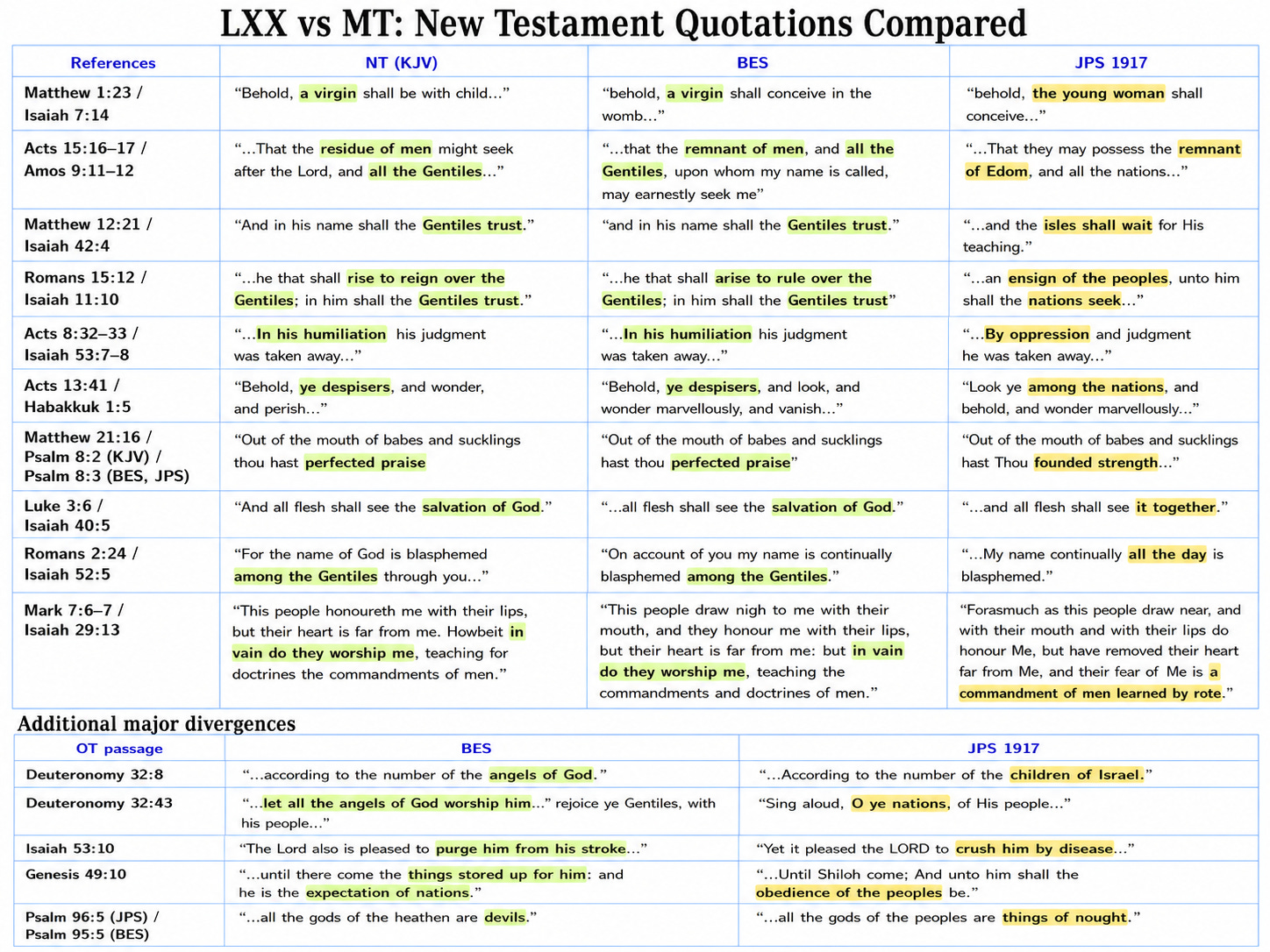
Though we will not touch on all the cited examples above, we begin with the ruling delivered by St. James at the Council of Jerusalem:
— Acts 15:16–17/Amos 9:11–12
And after they had held their peace, James answered, saying, Men and brethren, hearken unto me:
Simeon hath declared how God at the first did visit the Gentiles, to take out of them a people for his name.
And to this agree the words of the prophets; as it is written,
After this I will return, and will build again the tabernacle of David, which is fallen down; and I will build again the ruins thereof, and I will set it up:
That the residue of men might seek after the Lord, and all the Gentiles, upon whom my name is called, saith the Lord, who doeth all these things.
— Acts of the Apostles 15:13–17 KJV
After the outbreak of the Judaizing controversy at the close of the 40’s AD, the Apostles had gathered to settle the matter in a synodal council. Christ is declared once again as the foretold Davidic King; the entrance of the nations into His Church is the fulfillment of that rebuilding process. This is the LXX reading, the later Hebrew text instead declares that a restored Israel will “possess the remnant of Edom, and all the nations.” Amos’s prophecy takes on a very different nature in the MT, one reflecting Rabbinic eschatology as opposed to a Messianic one. (We discuss the so-called Noahide laws and the fate of Gentiles under Rabbinic rule in further detail in The Judeo-Christian Paradox, Part III.)
— Matthew 12:21/Isaiah 42:4
That it might be fulfilled which was spoken by Esaias the prophet, saying,
Behold my servant, whom I have chosen; my beloved, in whom my soul is well pleased: I will put my spirit upon him, and he shall shew judgment to the Gentiles.
He shall not strive, nor cry; neither shall any man hear his voice in the streets.
A bruised reed shall he not break, and smoking flax shall he not quench, till he send forth judgment unto victory.
And in his name shall the Gentiles trust.
— The Gospel of Matthew 12:17–21 KJV
St. Matthew identifies Christ as the Servant of Isaiah’s gospel and the LXX contains this precise reading. The MT says that the islands will wait for the Servant’s teaching, the islands and sea being a common OT motif for the Gentile nations. In the LXX, the Messiah Himself becomes the object of Gentile faith. While both readings extend the Servant’s work beyond Israel’s earthly borders, the theological emphasis differs considerably.
— Romans 15:12/Isaiah 11:10
Now I say that Jesus Christ was a minister of the circumcision for the truth of God, to confirm the promises made unto the fathers:
And that the Gentiles might glorify God for his mercy; as it is written, For this cause I will confess to thee among the Gentiles, and sing unto thy name.
And again he saith, Rejoice, ye Gentiles, with his people.
And again, Praise the Lord, all ye Gentiles; and laud him, all ye people.
And again, Esaias saith, There shall be a root of Jesse, and he that shall rise to reign over the Gentiles; in him shall the Gentiles trust.
— Epistle to the Romans 15:8–12 KJV
St. Paul gathers a succession of OT passages to prove that the mercy promised to Israel always had the Gentiles in mind, uniting the nations once again in the worship of the True God. The LXX reads accordingly: “He that shall arise to rule over the Gentiles; in him shall the Gentiles trust.” The MT presents the Root as an ensign of the peoples, unto whom the nations shall seek. The MT remains Messianic, though it lacks the two statements which St. Paul emphasizes: the Messiah personally reigns over the Gentiles, and the Gentiles place their trust in Him.
— Acts 13:41/Habakkuk 1:5
Be it known unto you therefore, men and brethren, that through this man is preached unto you the forgiveness of sins:
And by him all that believe are justified from all things, from which ye could not be justified by the law of Moses.
Beware therefore, lest that come upon you, which is spoken of in the prophets;
Behold, ye despisers, and wonder, and perish: for I work a work in your days, a work which ye shall in no wise believe, though a man declare it unto you.
— Acts of the Apostles 13:38–41 KJV
The LXX version of Habakkuk begins, “Behold, ye despisers.” The MT begins, “Look ye among the nations.” Clearly St. Paul is preaching Christ in the synagogue at Antioch from the LXX, a fact which would help to explain the longer Judges timeline he refers to, though the 450-year reference remains a thorny one for advocates of either textual tradition. Habakkuk, as quoted by Paul, condemns those who behold God’s work and refuse to believe, while the later Hebrew turns that attention outward toward the Gentiles instead. Such a change affects the whole force of the citation.
— Matthew 21:16/Psalm 8:2
And the blind and the lame came to him in the temple; and he healed them.
And when the chief priests and scribes saw the wonderful things that he did, and the children crying in the temple, and saying, Hosanna to the Son of David; they were sore displeased,
And said unto him, Hearest thou what these say? And Jesus saith unto them, Yea; have ye never read, Out of the mouth of babes and sucklings thou hast perfected praise?
— The Gospel of Matthew 21:14–16 KJV
The children recognize the Son of David while the rulers of Israel yet oppose Him. When the Pharisees object to the praise being offered to Christ, Jesus answers with the LXX rendering of Psalm 8. The MT instead reads that YHWH has “founded strength.” Citing the LXX, Christ receives praise and justifies it with a passage concerning praise directed toward YHWH, identifying Himself as the God to whom such praise is rightly directed. The implication of this change is unmistakable.
— Romans 2:24/Isaiah 52:5
Behold, thou art called a Jew, and restest in the law, and makest thy boast of God,
And knowest his will, and approvest the things that are more excellent, being instructed out of the law;
And art confident that thou thyself art a guide of the blind, a light of them which are in darkness,
An instructor of the foolish, a teacher of babes, which hast the form of knowledge and of the truth in the law.
Thou therefore which teachest another, teachest thou not thyself? thou that preachest a man should not steal, dost thou steal?
Thou that sayest a man should not commit adultery, dost thou commit adultery? thou that abhorrest idols, dost thou commit sacrilege?
Thou that makest thy boast of the law, through breaking the law dishonourest thou God?
For the name of God is blasphemed among the Gentiles through you, as it is written.
— Epistle to the Romans 2:17–24 KJV
The LXX reads, “On account of you my name is continually blasphemed among the Gentiles.” The MT retains the blasphemy of God’s name but omits both the Gentiles among whom it occurs and the men through whom it is occasioned — namely, Israel. The LXX preserves this humiliating indictment, while the MT lacks it entirely. The reasons for such an excision are self-evident.
— Mark 7:6-7/Isaiah 29:13
Then the Pharisees and scribes asked him, Why walk not thy disciples according to the tradition of the elders, but eat bread with unwashen hands?
He answered and said unto them, Well hath Esaias prophesied of you hypocrites, as it is written, This people honoureth me with their lips, but their heart is far from me.
Howbeit in vain do they worship me, teaching for doctrines the commandments of men.
For laying aside the commandment of God, ye hold the tradition of men, as the washing of pots and cups: and many other such like things ye do.
And he said unto them, Full well ye reject the commandment of God, that ye may keep your own tradition.
— The Gospel of Mark 7:5–9 KJV
The MT says that Israel’s fear of God has become “a commandment of men learned by rote,” an indictment of empty ritualism as opposed to man-made traditions overruling the commandments of God. Christ’s words, once again, follow the LXX exactly.
The examples left unexamined are no less striking. Speaking of the Incarnation, Hebrews 10 places the words “a body hast thou prepared me” upon the lips of Christ, while the MT reads only “mine ears hast thou opened.” Christ almost certainly reads from the LXX form of Isaiah 61 in the synagogue (Luke 4). St. Philip encounters the Ethiopian reading the LXX form of Isaiah 53 and begins from that Scripture to preach Jesus. St. Luke announces that “all flesh shall see the salvation of God,” again following the Greek version of Isaiah, while Hebrews 1 commands the angels to worship the First begotten in words preserved within the Greek OT yet entirely absent from the Masoretic.
As one can plainly see, these textual differences repeatedly arise where the controversy between the Church and the synagogue was most acute: the divine identity of the Messiah, the restoration of the Gentiles beneath His rule, and the condemnation of those who rejected Him whilst claiming authority over the Scriptures they abuse.
Epilogue
The decisive question this study has explored is whether the later Rabbinic text faithfully preserves the Scriptures known to Christ, His Apostles, and the early Church.
At too many consequential points, it plainly does not.
Historically, Rabbinic Judaism has defined itself in opposition to the Church. Its literature answered the Gospel with counter-narratives attacking His conception, His miracles, His authority, His death, and His resurrection. The same conflict surrounded the Scriptures, as new Jewish translations were produced against the Greek readings used by Christians. Certainly manuscripts may suffer corruption and scribes make mistakes in their transmission of texts, yet ordinary scribal errors do not account for the consistency of the evidence presented here. The MT developed within a sustained anti-Christian environment, and the readings which disappeared or changed repeatedly serve the very arguments the rabbis sought to defeat.
On the other hand, the LXX was translated by Judeans before the birth of Christ, received throughout the Greek-speaking world, quoted continuously within the NT, and inherited by the Church as its OT. The Dead Sea Scrolls have repeatedly demonstrated that readings once treated as Greek anomalies were already present in ancient Hebrew manuscripts. Josephus and the Samaritan Pentateuch preserve further evidence of textual traditions differing substantially from the MT. The tired Protestant dialectic between the “original” Hebrew Bible and an inferior Greek translation is, to put it mildly, historically untenable.
When I began research for this series, I still carried many assumptions inherited from my Protestant upbringing concerning the contents of the OT. The Hebrew Bible preserved by Rabbinic Judaism is presumed to represent the original form of Scripture, while the LXX is treated as a useful but secondary translation — if it is even acknowledged at all. Researching this subject over the years and writing these chapters has substantially altered those convictions. While that inquiry belongs to another essay, for now I can say only that my former assumptions concerning what the OT should and should not contain have not survived this study intact.
The OT can not be read without an oral tradition. For nearly every modern Christian who opens a Bible in the West, that oral tradition is supplied by the Masoretes and perpetuated by their successors, knowingly or otherwise. Protestant scholars may appeal to the ancient Hebrew, but in practice it is still an interpretation of the Masoretic text. When it comes to the Scriptures, we can not escape tradition — the English speaking world has merely exchanged one body of tradition for another.
The LXX is, and rightly should be, the Christian OT.
— Erasing the Messiah III, digital art, 2026.
“Many, I know, respect the Jews and think that their present way of life is a venerable one. This is why I hasten to uproot and tear out this deadly opinion. I said that the synagogue is no better than a theatre and I bring forward a prophet as my witness. Surely the Jews are not more deserving of belief than their prophets. “You had a harlot’s brow; you became shameless before all”. Where a harlot has set herself up, that place is a brothel. But the synagogue is not only a brothel and a theatre; it also is a den of robbers and a lodging for wild beasts. Jeremiah said: “Your house has become for me the den of a hyena”. He does not simply say “of wild beast”, but “of a filthy wild beast”, and again: “I have abandoned my house, I have cast off my inheritance”.
But when God forsakes a people, what hope of salvation is left? When God forsake a place, that place becomes the dwelling of demons.”
— St. John Chrysostom, Archbishop of Constantinople. Adversus Judaeos (Homily I)
Get Scipio’s latest book, The Empire of Lies: the American Empire unmasked.
Hit the Tip Jar and help spread the message!
This post contains affiliate links, which means I may receive a commission or affiliate fee for purchases made through these links.
Meet Scipio & get practical tools for wellness and preparedness at the Sovereign Health Summit — save 5% with promo code SCIPIO.
Unlock the mysteries of Biblical cosmology and enrich your faith with some of the top rated Christian reads at BooksOnline.club.
Click the image below and be sure to use promo code SCIPIO for 10% off your order at HeavensHarvest.com: your one stop shop for emergency food, heirloom seeds and survival supplies.
Further Research

Rebooting the Bible: Exposing the Second Century Conspiracy to Corrupt the Scripture and Alter Biblical Chronology (Part 1) by S. Douglas Woodward

Translation of the Seventy: History, Reception, and Contemporary Uses of the Septuagint by Edmon L. Gallagher

The Septuagint: What It Is and Why It Matters by Gregory R. Lanier & William A. Ross

The Biblical Canon: Its Origin, Transmission, And Authority (3rd Edition) by Lee Martin McDonald

The Formation of the Biblical Canon, Volume I: The Old Testament: Its Authority and Canonicity by Lee Martin McDonald

Glad you are on board with the LXX now. I came to this conclusion many months ago, and so have several others in my circle of influence. The "KJV-only" celebrity pastors have lost my respect entirely (and you know who they are) because it has taken the "laity", not them, to search this out and expose it. And of course this has monstrous implications for true followers of Christ, for if the jews have perpetrated this gigantic deception, what else have they done? How about fake Dead Sea scrolls? Fake names for God the Father? Is there no end to their lies? https://benbornagain.faith/pages/jesus-or-yeshua?_pos=1&_sid=00a3bda40&_ss=r
fascinating series, thanks for the tables illustrating the discrepancies.